
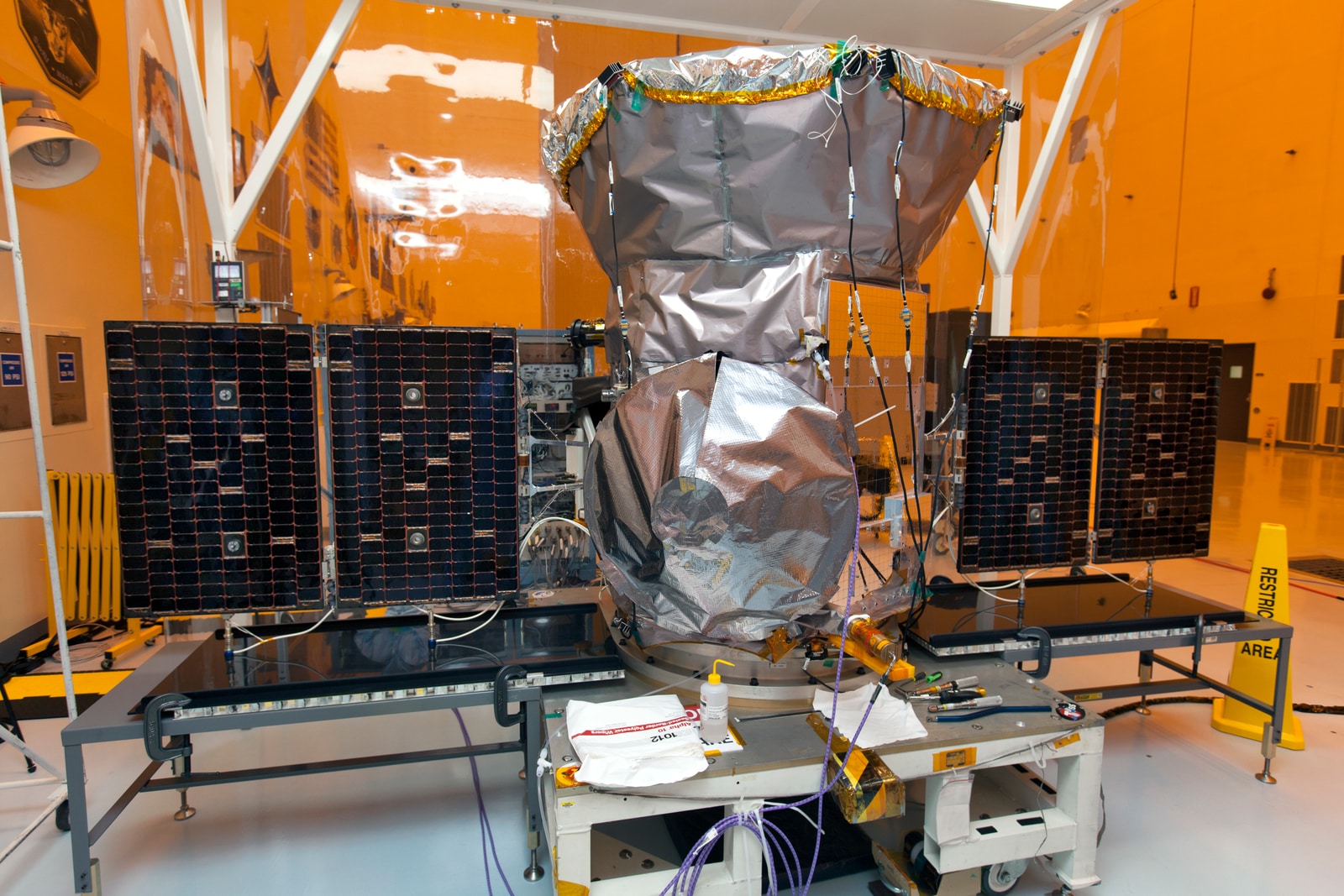
A planet-hunting satellite finds objects closer to home
NASA’s TESS satellite spends weeks at a time looking for shadows that planets cast across nearby stars. Those same exposures can show something moving much closer to home. Astronomers led by Te Han at MIT report that they linked 11 previously unrecognised outer-solar-system objects across the satellite’s archive and found them again in ground-based images, some collected before TESS launched. The team reports eight additional candidates with evidence from the satellite alone.
The study, in an arXiv preprint dated November 16, looked through TESS exposures taken between July 2018 and November 6, 2026. The team searched 572 detector fields across 95 observing sectors, concentrating close to the plane of Earth’s orbit. Every one of the 11 objects appeared in at least two sectors before the team compared the proposed tracks with observations from other telescopes. That last step matters. In a data set this large, apparently consistent motion can emerge from defects in the images or from two separate objects crossing the wrong paths at the right times.
A moving object only comes into focus on the right track
For exoplanet work, TESS watches for small changes in the brightness of individual stars as a planet passes in front. Its cameras also save full-frame images. A distant solar-system body can leave too little light in any one exposure to be spotted reliably, yet its motion changes where that light should appear over days.
The researchers modelled the stars using ESA’s Gaia catalogue and subtracted their expected contribution. They then tried a large set of paths through the remaining images. Picture a stack of transparent sheets with a faint dot at a different position on each sheet. Align the sheets along the right curve and the dot’s light adds up. Choose the wrong curve and it smears out. The curvature matters because TESS observes from a moving vantage point, and part of the apparent drift comes from that change in perspective.
Even a promising streak could be left by scattered light, an electronics artefact or an object closer in. In some near-ecliptic exposures, electronics can make false copies of Uranus or Neptune elsewhere on the detector. The team ran a control search backwards through the same data to estimate how often the procedure would make a detection where a real track should be absent. It also required observations from different sectors to fit one plausible orbit.
The follow-up was already sitting in other archives
An orbit fitted from TESS provided a place and time to check. The researchers searched data from telescopes including Pan-STARRS1, the Blanco telescope’s Dark Energy Camera and the Canada–France–Hawaii Telescope. Some detections were visible in individual ground exposures. Others emerged when observations from the Zwicky Transient Facility were combined along the proposed path.
For example, the paper’s TESS TNO-5 appeared in three TESS sectors. Images from the Canada–France–Hawaii Telescope extended its observed history back to 2003, giving it an arc of about 20 years. That is the span between observations, a useful constraint on a slow orbit that takes centuries to complete. The evidence is thinner for TESS TNO-10, which has only one night of usable Dark Energy Camera observations alongside a detection in a Zwicky Transient Facility stack. The paper identifies that limitation. Eight other linked signals await comparable ground-based evidence.
The same search found 314 objects that were already known, including Centaurs, the population of small bodies whose orbits typically cross the region of the giant planets. One was 2026 ED138, a separate dwarf-planet candidate announced by the Vera C. Rubin Observatory in October. The TESS team found images of it from June 2019. The sequence illustrates how one telescope can discover an object and an older archive can lengthen the record after the fact. ED138 sits outside the count of 11 new finds.
What the search tells us about the outer solar system
The 11 objects were about 25 to 57 times Earth’s distance from the Sun at the reported observations. The lower end is inside Neptune’s typical orbital distance. An elongated orbit can bring an object inward for part of its journey even when the orbit’s semimajor axis, a measure of its size, extends beyond Neptune’s.
The largest estimated object, TESS TNO-2, was around 57 Earth–Sun distances out. Its brightness implies a diameter of about 910 kilometres under the authors’ common assumption for visible-light reflectivity, a geometric albedo of 0.08. A more reflective surface would mean a smaller object for the same measured light. The diameter is an estimate; its shape and dwarf-planet status remain open.
The paper’s known-object check puts half-recovery near visual magnitude 21.6 before quality cuts. That is an empirical sensitivity check for this search. Results depend on the regions and speeds the team looked at and on whether ground-based data existed to check the TESS tracks. The authors propose testing the complete method with artificial objects inserted into the data before cleaning. That would show how much of the true population the procedure misses. The team also disclosed using AI tools for assistance with analysis code, figures and manuscript preparation.
Rubin can see fainter objects with sharper resolution. TESS covers northern fields that Rubin cannot reach and can supply positions from years earlier. The most immediate next test is to point a ground telescope toward the eight remaining candidates and see whether their predicted tracks hold. The 11 backed by existing exposures already show why old observations remain valuable after a mission’s original question has changed.
Sources & Methods
Lumacta read the preprint’s methods, diagnostics and ground-observation tables, checked the instrument against NASA and compared the ED138 timeline with Rubin’s independent discovery report. The preprint’s independent ground images were analysed by its own authors. Prepared with AI assistance.
- Te Han and colleagues’ TESS archive study — Original research preprint and observational tables
- arXiv submission record for the TESS archive study — Original repository record
- NASA’s TESS mission overview — Primary mission documentation
- Rubin Observatory announces its dwarf-planet candidate — Independent discovery team's primary observation record
- Earlier study of searching for distant bodies in TESS images — Independent primary study of the method
- NASA’s archive record for the TESS photograph — Original photograph metadata and photographer credit