
A known release gives the measurement something independent to answer to
Stanford reports 481 controlled methane releases at Casa Grande, Arizona, during 2025; its account appeared October 14.
The scientific advantage is a reference that exists separately from the image interpretation. Agreement between two algorithms is not the same as agreement with a metered input: algorithms could share an assumption and therefore share an error. A controlled experiment can ask which answer matches the deliberately supplied quantity.
Blinding strengthens that question by separating an analyst’s estimate from advance knowledge of the answer. It does not eliminate every bias or make one site representative of everywhere. Our interpretation is that the study supplies a stronger calibration opportunity, not a certificate that any future alert must be correct. Those are different evidential claims.
Source notes: 1, 2. Original editorial examples and interpretations are identified separately.
A good alarm and a precise flow estimate need different scores
The Nature abstract describes 746 events, including 265 blank controls. Dedicated methane instruments achieved 92–100 percent true-positive rates under clear skies; their emission estimates had a 44 percent mean absolute percentage error. Its conclusion concerns sources whose locations are approximately known.
An alarm answers whether a plume is present. A rate estimate answers how much gas passes per unit time. A detector can answer the first question correctly while its estimate of the second remains substantially different from the reference. Neither score can stand in for the other.
Mean absolute percentage error also differs from a signed average. With absolute errors, an overestimate does not cancel an underestimate. For interpretation, we would ask for the error distribution and operating conditions alongside the headline mean. That is a proposed scrutiny step, not a claim that we inspected the unavailable full paper’s individual estimates or uncertainty calculations.
Here is separate, original arithmetic: suppose two real releases are each 100 units per hour, while the estimates are 60 and 140. Their signed errors are minus 40 and plus 40 percent, averaging zero. Their absolute percentage errors are both 40 percent. This invented pair shows how an apparently unbiased average can coexist with substantial individual errors; it does not reconstruct the reported instrument results.
Source notes: 2. Original editorial examples and interpretations are identified separately.
Why the number of uneventful checks changes the meaning of an alert
Consider an original, invented detector with 80 percent sensitivity and a 10 percent false-positive rate. These are teaching assumptions, not the study’s measurements. In 100 checks with a real plume and 100 without one, it produces an expected 80 true alerts and 10 false alerts. Among its 90 alerts, 80 ÷ 90, or about 88.9 percent, are true.
Now give that same imaginary detector 1,000 checks, only 10 of which contain a plume. Holding those assumed rates fixed gives eight true alerts and 99 false alerts: 10 × 0.8 and 990 × 0.1. Only 8 ÷ 107, about 7.5 percent of its expected alerts, correspond to real plumes.
The detector has not become worse in this arithmetic; the mixture of inputs has changed. These are expected counts under fixed assumptions, not a forecast for any satellite. The exercise shows why translating a controlled-test percentage into an investigation workload requires the frequency of real events as well as the error rates.
Source notes: 2. Original editorial examples and interpretations are identified separately.
Clouds do not turn a missed observation into a clean bill of health
Stanford describes reflected-infrared methane sensing, cloud-related limitations and the need for research beyond desert conditions.
Our physical interpretation is that a measurement depends on the complete observation opportunity, not just the sensor’s name. A useful signal must reach the instrument and remain distinguishable in the analysis. An unusable observation and a usable observation with no detected plume therefore belong in different categories.
For a monitoring programme, we would track attempted observations, usable observations and confirmed detections separately. Treating every unavailable look as a negative finding would make an interrupted observing schedule resemble successful surveillance. Conversely, discarding difficult cases without reporting their number could exaggerate practical coverage. This is an original evaluation framework, not a reconstruction of the study’s cloud-screening procedure.
Source notes: 1. Original editorial examples and interpretations are identified separately.
The reported AI share of false alarms is not an AI failure probability
Stanford attributes 79 percent of false positives to commercial teams applying AI methods to general-purpose land-scanner data.
A share of the false-positive pool is not the probability that an AI estimate is false: those questions have different denominators. The first groups the mistakes and asks where they originated. The second starts with all evaluations by the method and asks how often it made that mistake. Converting one into the other requires additional counts; the percentage alone cannot supply them.
Our scientific conclusion is therefore conditional: investigate the particular methods and data, rather than declaring all AI sensing either vindicated or disproved. For a proposed follow-up comparison, we would hold the test inputs constant and report missed plumes, false alarms and rate-estimation errors separately. We have not run that comparison, and a strong result on one score would not settle the other two.
Source notes: 1, 2. Original editorial examples and interpretations are identified separately.
A useful satellite alert begins an investigation rather than completing it
For a practical decision, our proposed evidence chain is observation, qualified alert, follow-up and documented outcome. Finding a likely source does not by itself demonstrate that it was repaired. An estimated reduction likewise needs a stated comparison period and measurement method before it becomes evidence of an avoided release.
This distinction gives the technology a meaningful role without promising automatic environmental success. A timely lead can help choose where to look; an imprecise estimate may still be operationally useful. But an investigation needs to preserve uncertainty rather than silently convert a suggested location into a confirmed source or a detection into a verified quantity.
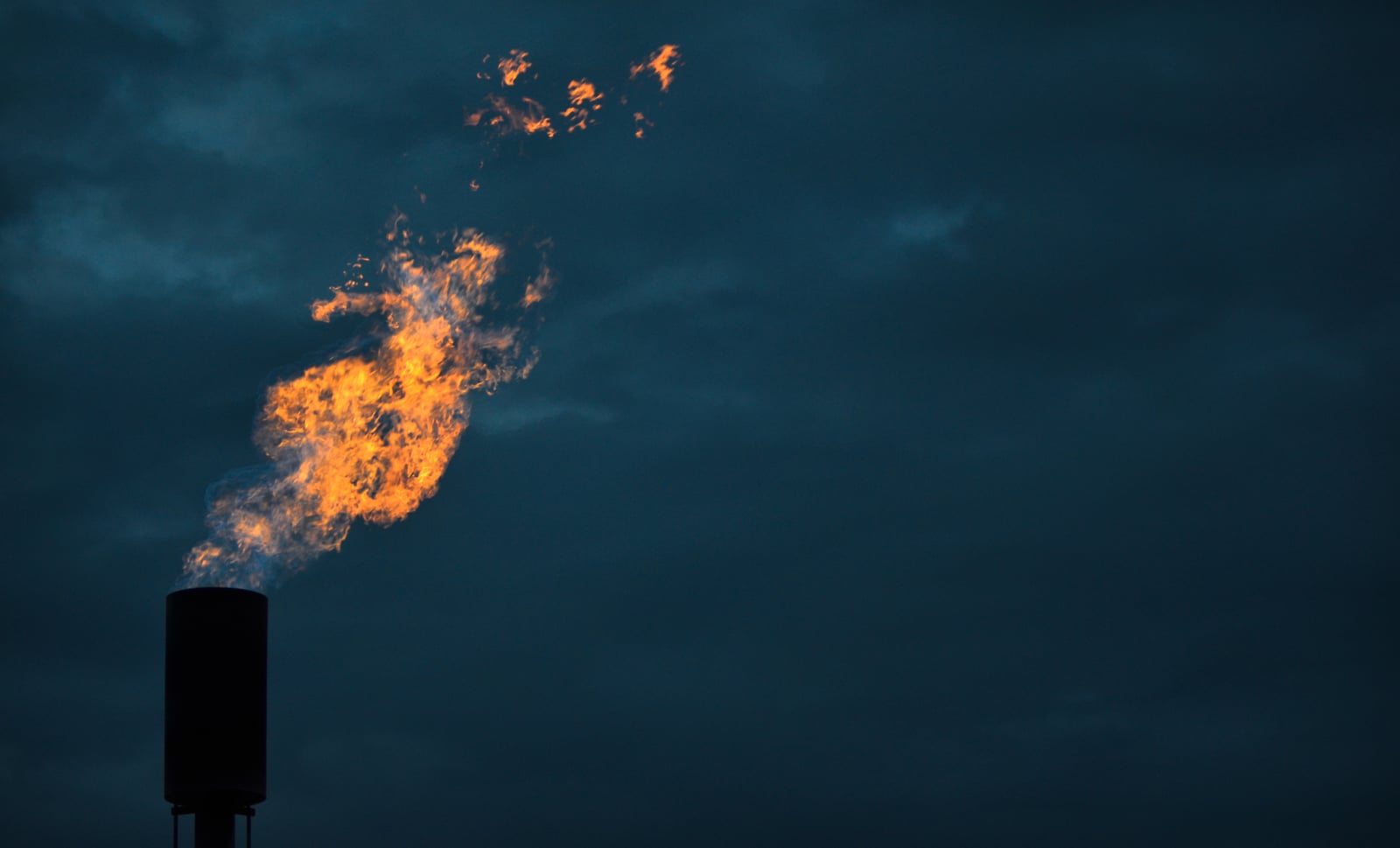
The accompanying photograph shows a landfill flare in 2016, not the Arizona experiment. It is archival subject context, not a satellite observation or an image of unburned gas escaping. Our assessment rests on the reported experimental evidence. Lumacta has not performed a release test, inspected a site or independently validated a monitoring service.
Source notes: 1, 3. Original editorial examples and interpretations are identified separately.
Sources & Methods
Prepared October 15, 2026. We read the complete Stanford institutional account and the publisher-indexed Nature abstract, publication details, funding and competing-interest statements. Direct journal access was unavailable; the full paper, supplement and raw observations were not read or reprocessed. The alert-count arithmetic and proposed monitoring framework are original editorial analysis, not study results. We read the complete Commons photograph record and CC BY-SA 4.0 deed. No interview, release experiment, independent satellite test or image capture was performed by Lumacta. The accompanying archive photograph is unrelated to the experimental site.
- Stanford: a controlled methane-monitoring trial — Primary institutional account, October 14, 2026; complete body read
- Nature: Evaluating space-based methane detection through a one-year blind test — Primary journal, October 14, 2026; indexed abstract and disclosures read, not full paper
- Wikimedia Commons: Methane Flare, by Carl Young — Own-work photograph record; complete description, attribution, licensing and metadata read
- Creative Commons: Attribution-ShareAlike 4.0 — Complete license deed read; commercial sharing and adaptation permitted subject to its terms
