
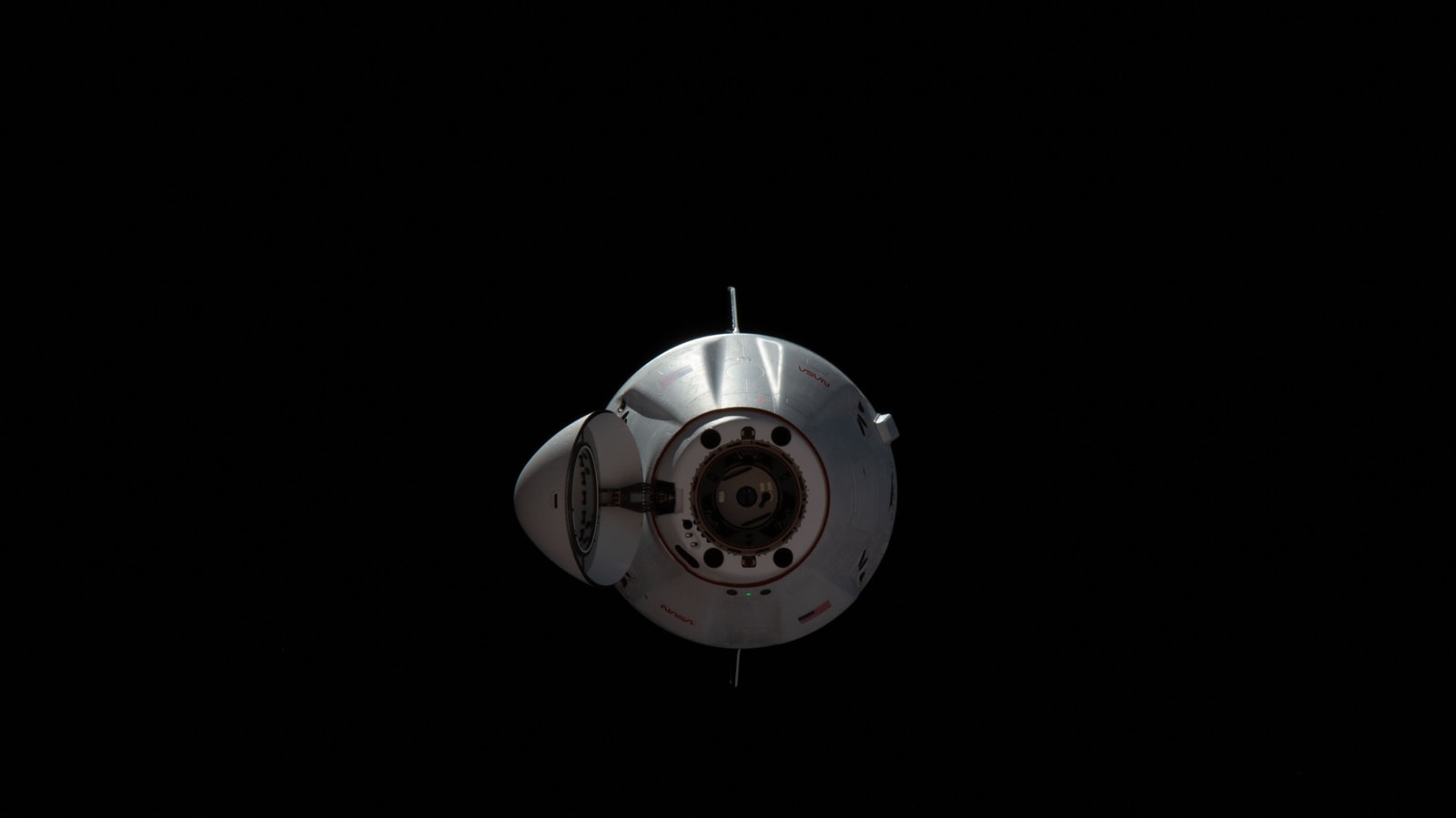
The capsule is back with research cargo
SpaceX's CRS-35 cargo Dragon has returned to Earth. NASA confirmed that the uncrewed spacecraft splashed down in the Pacific near Los Angeles on November 21 at 2:03 p.m. Pacific Standard Time, equivalent to 22:03 UTC. The landing completed the company's thirty-fifth commercial resupply mission for the agency.
The return brings physical research material closer to the laboratories that can examine it. For readers following space science, that is the useful consequence of the landing. The next important evidence will come from the condition of the returned material, the analysis performed on it and the comparisons researchers can make.
A completed landing replaces the earlier target
NASA's departure report placed undocking at 12:05 p.m. Eastern Standard Time on November 20, from Harmony's space-facing port. The return announcement gives the same departure as 11:05 a.m. Central Standard Time. Those are the same moment, 17:05 UTC, about 29 hours before splashdown.
The agency had previously aimed for a landing at approximately 1:55 p.m. Pacific time. The confirmed event came eight minutes later. An earlier departure opportunity had been dropped because of unfavorable recovery-area weather. This sequence shows why a planned time belongs in a preview, while a completed mission report needs the subsequent operational confirmation.
The cargo contains several different scientific questions
NASA's return manifest includes bioprinted vessel material for cardiovascular research and treated tumor organoids for cancer-related studies. Frozen microbial samples and a lighting system that spent more than three years aboard the station also came back. These are research materials and equipment, with their conclusions still to be established.
The range matters. A returned biological sample can be examined for changes that were preserved during the experiment. A returned piece of equipment can be inspected for how it performed over time. Each investigation needs an evaluation matched to its question. A single successful recovery cannot supply one common measure of scientific success for the entire load.
The return leg is a distinct scientific capability
Space.com's reporting notes that Dragon can bring substantial cargo back from the station, while the currently operating Cygnus, Progress and HTV-X supply vehicles end their missions in destructive reentries. For experiments requiring physical examination on Earth, the available return route therefore shapes what can be studied.
Consider an investigation that produces both instrument readings and a physical specimen. The readings describe what the equipment recorded during the experiment. Access to the specimen lets a laboratory ask additional questions about its condition and structure. The scientific opportunity comes from connecting those forms of evidence through a documented experiment.
Source notes: 2.
Preparation is part of the evidence chain
NASA's November 18 packing report described crew blood collection and the loading of research material from freezers, incubators and other storage. It also listed a spacesuit returning for refurbishment. The crew's work covered scientific samples and hardware with different requirements, all sharing the same journey home.
Our reading is that sample history deserves attention alongside the landing. A convincing account of a result should identify what was collected, how it was kept and what comparison was used. That information helps readers distinguish a change associated with the experiment from a difference that could arise during handling. The arrival report does not provide that level of detail for every returned item.
Source notes: 4.
Keeping a sample useful takes more than cold storage
NASA's Johnson Space Center cold-stowage fact sheet describes a system spanning ascent, orbital operations and return. It includes active refrigerators and freezers alongside insulated containers that maintain a controlled environment using phase-change materials. The document explains the general infrastructure, without specifying which device carried each CRS-35 sample.
The practical point is continuity. A preservation requirement follows the material through successive transfers. A refrigerator aboard the station solves one part of that problem, and the return journey introduces further handovers. For this mission, a complete scientific account would connect the experiment record to the ground laboratory's assessment of what arrived. The public landing announcement supplies the transport outcome.
Source notes: 5.
How to judge the findings that come next
For the medical investigations, the decisive questions will concern the model studied, the comparison group, the measurements and the uncertainty. A promising change in an experimental model can justify further work. Its relevance to patients depends on evidence that connects the model to the proposed application, including confirmation beyond the initial experiment.
For example, imagine a returned specimen differs from a similar specimen kept on Earth. A useful report would explain how the two were selected, what conditions they shared and which differences the experiment was designed to examine. A photograph of the returned material would answer only a small part of that question. Measurements, controls and a clear account of the procedure would let other researchers assess the proposed explanation. This is an illustration of how to read a future paper, with no claim that a particular CRS-35 investigation used this design.
The lighting investigation calls for a different reading. Evidence about long-running equipment, measured conditions and crew experience could each answer a useful question, but they would support different claims. When results are published, readers should look for the particular outcome measured and the conditions under which it was measured before extending the conclusion to a future mission.
The value of the landing is the work it enables
Lumacta's assessment is that CRS-35's return is best understood as an enabling milestone. A research programme needs ways to move equipment and preserve samples as well as ways to launch them. Completing that loop gives investigators the opportunity to turn orbital work into evidence that others can scrutinize.
The next developments worth following are the investigators' assessments and published analyses. Look for a clear link between the question, the returned material and the conclusion. That is where the scientific value of this recovery will become visible.
Sources & Methods
We read NASA's completed-return and undocking reports, its sample-packing account, independent reporting by Mike Wall and a NASA cold-stowage reference. Event times are converted from the stated US standard-time zones. The discussion of evidence quality is Lumacta analysis.
- NASA confirms Dragon's return — Primary completed-event report dated November 21, 2026. Confirms 2:03 p.m. PST splashdown and the returned research load.
- Space.com reporting on the completed return — Independent reporting by Mike Wall, updated November 22 at 02:18 UTC. Used for the cargo-return comparison; NASA supplies the timeline.
- NASA's actual undocking report — Primary November 20 report of the completed departure. Its later splashdown time was still a forecast.
- NASA's sample-packing report — Primary November 18 operational account of the weather stand-down, research loading and return hardware.
- Johnson Space Center cold stowage — Historical NASA engineering fact sheet, hosted in the April 2021 directory. Read for general preservation infrastructure, not as a CRS-35 equipment manifest.
- NASA photograph iss075e0226573 — NASA/JSC documentary photograph dated October 15, 2026. Shows the approach to the station, before the November return.
- NASA factual-news media guidance — NASA imagery policy read November 23. Factual editorial reuse with credit, no implied endorsement and no third-party copyright marker on the selected record.