
A platform announcement is not a new pair of headphones
Qualcomm introduced Snapdragon Sound Elite Gen 2 on September 23 as an audio platform for AI-enabled wearables. The company’s audio catalogue distinguishes components and platform families; those listings should not be read as finished-headphone reviews. The announcement does not guarantee that a particular pair of earbuds is on sale with every advertised capability.
This distinction matters because the same platform can appear in products with different batteries, microphones, software and service arrangements. The chip announcement explains what manufacturers can build around. It does not settle which features a buyer will receive, in which language or country, or at what price.
Lumacta would treat this as an architecture to watch rather than a reason to replace working headphones immediately. The decision becomes meaningful when an actual product can be evaluated for the listening and assistance tasks its owner needs.
Source notes: 1, 4. Analysis and proposed examples are identified in the text.
Local AI and direct cloud access solve different problems
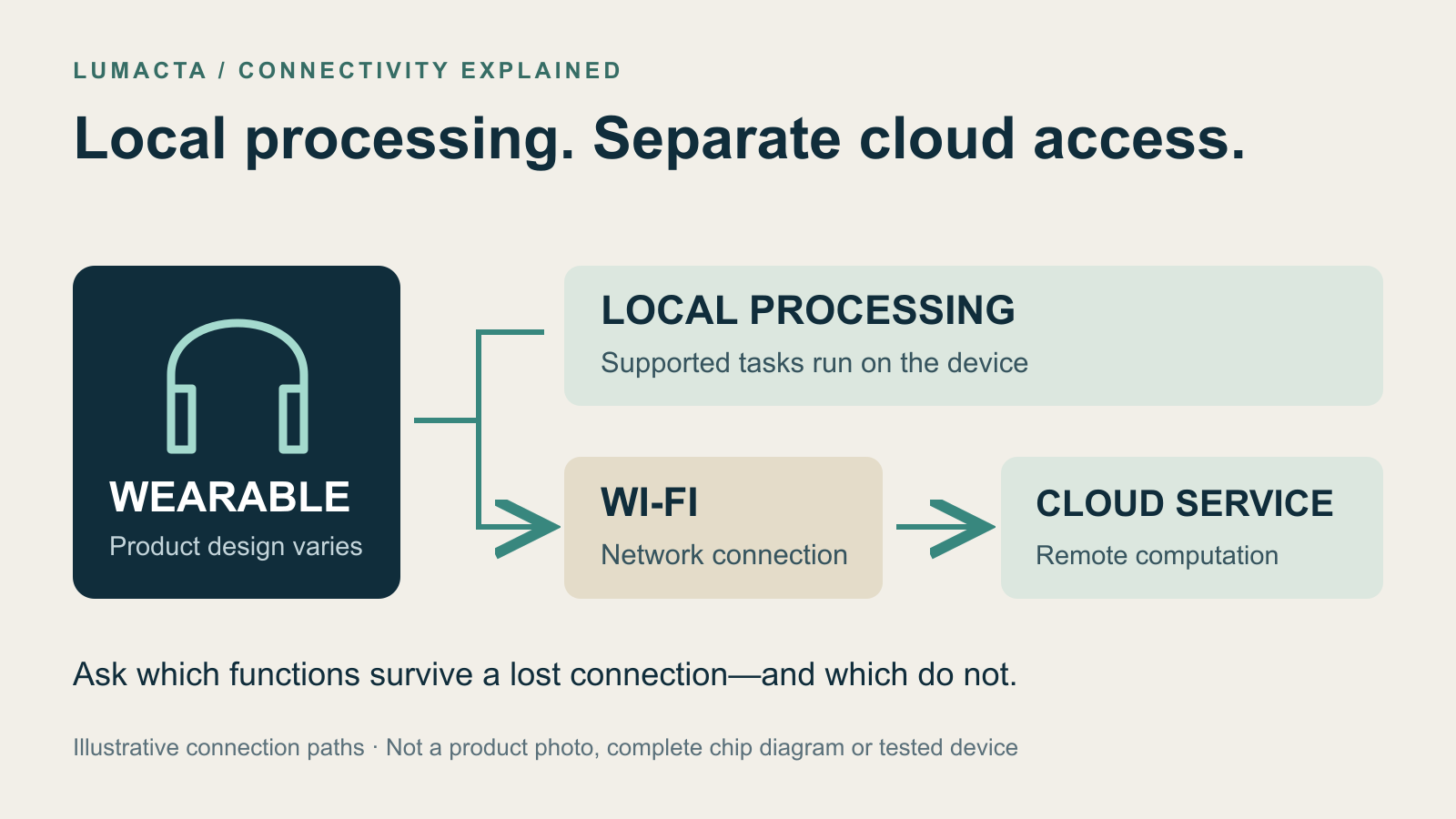
The specification lists 128 GOPS of AI acceleration and micro-power Wi-Fi 6E across the 2.4, 5 and 6 GHz bands. It also describes direct-to-cloud services. GOPS measures a stated peak operations rate; it is not a score for the accuracy of an assistant or the quality of a conversation.
Qualcomm’s September 24 explanation envisages voice, sensing and sometimes vision feeding services through future hearables. A camera-equipped Cleer concept illustrates the direction, but it is not evidence that every device using the platform will include a camera or ship those experiences.
Our interpretation: removing a phone from part of a connection path does not remove the network requirement of a cloud service. Buyers should ask which functions remain available offline, which need Wi-Fi and which require a paired device. Those questions are more useful than applying the label “standalone” to the entire product.
Source notes: 2, 3. Analysis and proposed examples are identified in the text.
The 40% power figure is not a measured listening-time gain
Qualcomm’s release advertises up to 40% lower power consumption, but its footnote specifies a Wi-Fi-connected idle scenario. It says the new-platform result comes from design simulation and remains subject to final silicon measurements. This is not a mixed-use battery test of retail earbuds.
The practical consequence is that we cannot turn that percentage into extra hours of music, calls or AI use. A complete product also has an audio path, radio activity, sensors, software and a battery chosen by its manufacturer. A more efficient component may be used to extend runtime, add features or reduce size.
Here is a deliberately hypothetical illustration, not a Qualcomm measurement. If one affected subsystem consumed 20 of a device’s 100 energy units, a 40% reduction in that subsystem would save eight units overall, assuming everything else stayed unchanged. Total energy use would fall from 100 to 92, not to 60. The exercise shows why the denominator matters.
Source notes: 1. Analysis and proposed examples are identified in the text.
Better connectivity still has to produce a better listening experience
The product page includes aptX Lossless, Qualcomm XPAN, adaptive noise cancellation and AI-enhanced voice processing. These are supported technologies, not an independent ranking against existing earbuds. A buyer still needs confirmation that the desired source device, app and listening mode work together in the finished product.
Our proposed comparison would keep the music, volume, phone or access point and environment consistent. Test calls as well as playback; include walking between rooms and temporarily losing connectivity. Record dropouts, reconnection time and whether the controls still respond. Repeat with AI assistance enabled and disabled where possible.
That would help distinguish an improvement in the listening experience from a demonstration that only works in one configuration. We have not run this comparison. Until independent product tests exist, a platform feature list should be treated as a set of possibilities and compatibility questions.
Source notes: 2. Analysis and proposed examples are identified in the text.
A useful assistant needs understandable boundaries
Qualcomm’s proposed uses include translation, contextual help and visual questions about the surrounding world. Those could be valuable when a screen is inconvenient. They also make it important to know what the device senses and when information leaves it.
Before buying, we would ask for a simple explanation of microphone and optional camera indicators, local versus remote processing, retention settings and a way to disable assistance without losing ordinary playback. An answer should name the service provider involved, not only the chip inside the product.
For a work call or a conversation involving other people, the question is not merely whether a feature is technically possible. It is whether the user can understand and control the particular recording or transmission involved. This is a product-evaluation checklist, not a claim that any announced implementation violates privacy rules.
Source notes: 3. Analysis and proposed examples are identified in the text.
Judge completed tasks, not an always-on slogan
The promising change is the ability to combine audio, local processing and a more flexible connection path in a small device. The unresolved part is the experience over an ordinary day: usefulness, interruptions, charging and control over data.
Our buying threshold would be a finished product that performs a specific task reliably while remaining good headphones. If a translation feature is the reason to buy, evaluate supported languages and behaviour when the connection fails. If the goal is better calls, prioritise microphone tests and comfort over theoretical AI throughput.
For now, keep the announcement in the “watch and verify” category. A simulated component-level efficiency gain and a new platform are meaningful development news. They are not yet a battery-life result or a recommendation for a retail device.
Source notes: 1, 2, 4. Analysis and proposed examples are identified in the text.
Sources & Methods
Prepared September 27, 2026 from Qualcomm’s September 23 announcement, September 24 strategy explanation and current product documentation. Manufacturer claims are attributed; the power footnote is kept separate from finished-device battery life. The 100-unit example is illustrative arithmetic, not test data. No sample access, hands-on review, purchase recommendation or independent benchmark is claimed.
- Qualcomm: Snapdragon Sound Elite Gen 2 announcement and test footnotes — September 23, 2026 primary announcement; simulation and comparison conditions
- Qualcomm: Snapdragon Sound Elite Gen 2 specifications — Manufacturer specifications and supported technologies; not independent performance evidence
- Qualcomm: the proposed role of personal-AI hearables — September 24 strategy post and concept-device context
- Qualcomm: audio-component catalogue — Component and platform-family context; no retail availability inferred