
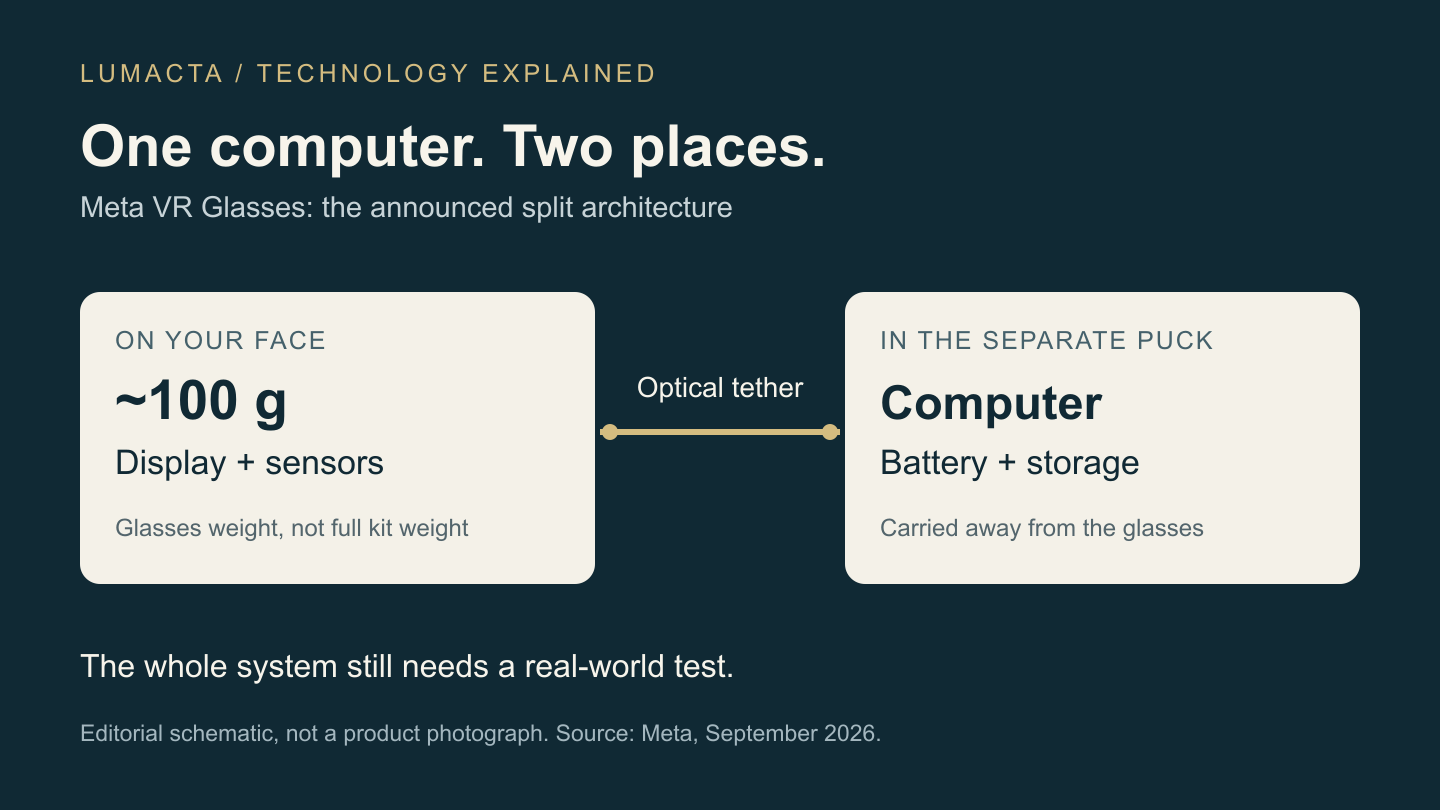
A two-part computer, with a future release date
Meta’s September 23 announcement puts VR Glasses at $1,299.99 in the US, with sales planned for spring 2027. The approximately 100-gram figure describes the glasses: a separate puck houses computing, storage and the battery, connected by an optical tether. The display uses micro-OLED panels, with a stated density of 37 pixels per degree. These are manufacturer specifications, not Lumacta measurements.
The engineering idea is easy to understand: move things that do not need to sit in front of your eyes somewhere else. The practical question is harder. A device can become more comfortable on the face while becoming less convenient to put on, carry or share. Buyers should evaluate that complete routine rather than judging only the smallest component.
Source notes: 1. Analysis and proposed examples are identified in the text.
What the headline weight leaves out
Our interpretation is that the split design trades one kind of inconvenience for another. Someone seated for a film might accept a cable readily. Someone repeatedly standing up, moving between desks or packing equipment may care more about where the puck and tether go. Neither use case can be settled by a weight figure alone.
A useful future review would weigh the complete kit, describe how the cable behaves and repeat an ordinary session long enough to reveal friction. Can you find somewhere sensible for the puck when your clothes have no pocket? Does standing up require a deliberate check? These are proposed evaluation questions, not problems we observed. We have not handled the product.
Source notes: 1. Analysis and proposed examples are identified in the text.
Sharper text and a wider view are different goals
Meta’s September 24 developer guidance describes a roughly 70-by-66-degree field of view, compared with 110 by 96 degrees for Quest 3. It also warns developers about interface elements near the edges and makes eyes and hands the primary input model, while supporting separately sold Touch Plus controllers. Its v207 development tools are available before the new hardware ships.
That combination suggests a different design target, not a universal upgrade in every direction. A film viewer may prefer a clear central image. A player who relies on peripheral awareness may value a wider view. A spreadsheet user needs readable cells, but also a comfortable way to move between them. Lumacta would test each task separately instead of letting a single display number stand in for all three.
For a developer, our first prototype test would be mundane: put the most important control near the center, then check how easily the user can find a secondary control without repeatedly turning their head. A simulator can help reveal layout mistakes, but it cannot establish how the finished glasses feel.
Source notes: 2. Analysis and proposed examples are identified in the text.
A workspace needs reliable corrections, not just impressive gestures
Meta’s input documentation treats hand and gaze interaction as a design discipline, with separate resources for pointing, grabbing, microgestures, limitations and reversible actions. That is a useful counterweight to the idea that removing a controller automatically makes every interaction simpler.
Consider our hypothetical editing task: select a sentence, correct a spelling error, move a window and return to the same paragraph. The meaningful result is not whether each gesture works once. It is whether the person can recover quickly when they select the wrong thing, without losing their place or making an unintended change.
We would compare completion time and correction count with the reader’s current laptop workflow. Keep the document and task identical, record failed selections as well as successes, and let the user choose the input method they can actually sustain. This is a proposed comparison, not a benchmark or a claim that a virtual keyboard replaces a physical one.
Source notes: 3. Analysis and proposed examples are identified in the text.
The content and battery questions come before the purchase
Meta quotes up to three hours of high-resolution media playback and describes selected entertainment partnerships. That is a bounded company claim, not a guarantee for mixed work or every streaming service in every country.
Our buying checklist would start with the exact activity that justifies the purchase. Confirm that the wanted app and content are available in your region, then check the full cost including subscriptions and optional accessories. For a travelling viewer, ask what remains usable without a reliable connection. For work, ask whether the necessary account, files and input tools are supported—not merely whether a window can be displayed.
There is no reason to assign value to an announced feature you would not use. Nor should an appealing cinema demonstration carry the burden of proving a professional workflow. Those are separate purchasing decisions.
Source notes: 1. Analysis and proposed examples are identified in the text.
The promising change is the architecture, not a proven replacement
Lumacta’s view: the design deserves attention because it changes where the inconvenience lives. It could make a personal display easier to wear without pretending that computing and battery requirements disappear. The next evidence should show whether the entire arrangement is pleasant enough to become a habit.
Until independent testing and final regional details arrive, treat this as a product to evaluate rather than an automatic upgrade. A successful session means finishing the film or the task comfortably, including setup and corrections. A lighter specification is a promising starting point; that completed experience is the result that matters.
Source notes: 1, 2, 3. Analysis and proposed examples are identified in the text.
Sources & Methods
Checked September 25, 2026 against Meta’s September 23 product announcement, September 24 developer update and input documentation. Specifications and launch plans are attributed to Meta. Scenarios and the proposed comparison are Lumacta analysis; no device access, hands-on test or independent performance verification is claimed.
- Meta: VR Glasses announcement (September 23, 2026) — Manufacturer claims, US price and future launch plan
- Meta: preparing applications for VR Glasses (September 24) — Developer specifications, field of view and SDK availability
- Meta: getting started with hands and eyes — Input-design documentation and links to limitations; not a usability study