
The announcement: two different starting points for a musical idea
Roland announced JUPITER-08 and n/vision on October 20. The former revisits the JUPITER-8 heritage; the latter is a new wavetable instrument. Both include a K-25m keyboard dock, a speaker and battery or USB-C power. These are manufacturer-described features, not a report of stock available to a Romanian buyer.
The interesting comparison is not a contest between names. A musician might want a recognizable starting sound that invites a quick performance, or a texture that changes while a scene develops. Those are different creative jobs. A compact device earns its place by making the intended job approachable, not merely by being another object on a desk.
For this explanation, imagine composing a short, original cue for a workshop film. A repeating figure introduces the room; a slower sound changes as the camera approaches an object. This is an invented assignment, not music we recorded or a demonstration of either instrument. It gives the specifications a purpose without pretending to replace a listening test.
Source notes: 1. Original editorial examples and interpretations are identified separately.
A voice count is not a count of keys, songs or musical ideas
Roland’s JUPITER-08 product page lists a maximum of 32 voices and describes a two-part sequencer with up to eight notes per step. Those quantities describe different functions; the product page does not turn them into a guarantee about every possible performance.
For an introductory working definition, think of polyphony as the capacity to keep sounding notes going at the same time. Releasing a key need not mean that the sound immediately disappears: a musical phrase may intentionally leave a tail behind it. The useful question is what happens during the passage you actually intend to play, not simply how many fingers touch keys at one instant.
In our imaginary cue, a sparse repeated figure and an overlapping sustained passage place different demands on the arrangement. More available capacity can be useful when the intended phrase requires it. It does not compose the phrase or establish that the result is more expressive. We have not measured voice allocation, note stealing or the response of a particular patch on this hardware.
Source notes: 2. Original editorial examples and interpretations are identified separately.
n/vision’s layers concern the sound—not two finished tracks
Roland describes n/vision’s two-layer wavetable architecture, upper and lower parts, and modulation of wavetable position and other parameters. Its specification lists up to 56 voices, explicitly varying with sound-generator load. That qualification belongs alongside the number, rather than disappearing from a comparison.
A layer is a way to construct a sound; a part organizes a separately usable musical role. Neither term should automatically become the number of final audio tracks a computer receives. Nor should two layers silently be translated into exactly two consumed voices per note: the internal accounting would need its own documentation.
For the slow portion of our fictional film cue, ask what should change while the note remains recognizable. Perhaps the beginning needs restraint and the later moment needs more motion. That is a sound-design intention, not an observation about n/vision’s quality. A changing texture can help a scene develop, but constant movement can also distract. Judge the relationship with the picture, rather than choosing the busiest sound because a device makes it possible.
Source notes: 3. Original editorial examples and interpretations are identified separately.
Original timing example: 64 steps do not mean 64 seconds
Both product pages list 64 steps. Sequence duration also depends on the timing assigned to each step—not on the count alone.
Here is an original arithmetic example, not a factory preset or a measured Roland sequence. Assume one sixteenth-note event per step, straight timing and four quarter-note beats per bar. Sixteen steps make one bar, so 64 steps make four bars. At an assumed tempo of 120 quarter-note beats per minute, a beat lasts half a second; four beats make a two-second bar. Four bars therefore last eight seconds.
Change those assumptions and the duration changes. The exercise does not establish either instrument’s default timing, a specific synchronization mode or a recorded result. For our fictional film, the useful decision is where the phrase should return and whether that return helps the edit. Repeating a loop is a musical choice, not a substitute for deciding how the scene develops.
Source notes: 2, 3. Original editorial examples and interpretations are identified separately.
A self-contained sketch and a computer session have different boundaries
Roland lists USB-C audio/MIDI interfaces, traditional MIDI connections and external clock inputs for both models. Their product specifications also describe battery and USB power. These are separate connections and functions, not a blanket claim that every cable or connected device supports every workflow.
For a sketch away from a computer, the immediate goal might be to capture a playable idea without opening a full production session. For an edit-room handoff, the goal changes: another person needs the musical result in a form the project can actually use. Powering a device, sending performance instructions and carrying recorded sound should remain distinct questions.
Before relying on a connection for an important job, establish which role the device at the other end performs and which operating instructions apply. We have not verified a phone connection, an individual audio driver or a multi-device clock arrangement. Our suggestion is to preserve a comprehensible version of the idea alongside the intended handoff, so a successful sketch does not become an unexplained dependency later.
Source notes: 2, 3. Original editorial examples and interpretations are identified separately.
Our assessment: choose a role before choosing the larger specification
For our fictional cue, the sensible comparison is a recognizable musical gesture versus a deliberately evolving texture, followed by how each fits the scene. Neither is inherently superior. A clear, restrained part can do more for an image than a complex patch whose movement competes with it. That judgment comes from the arrangement, not a specification table.
A useful future audition would keep the musical intention fixed while exploring each instrument’s way of reaching it. Listen to the phrase, its transitions and the space it leaves for speech. These are proposed evaluation conditions, not sound tests we performed, claims of vintage authenticity or a matched buying verdict. Keeping an existing instrument or software setup can be a perfectly reasonable outcome.
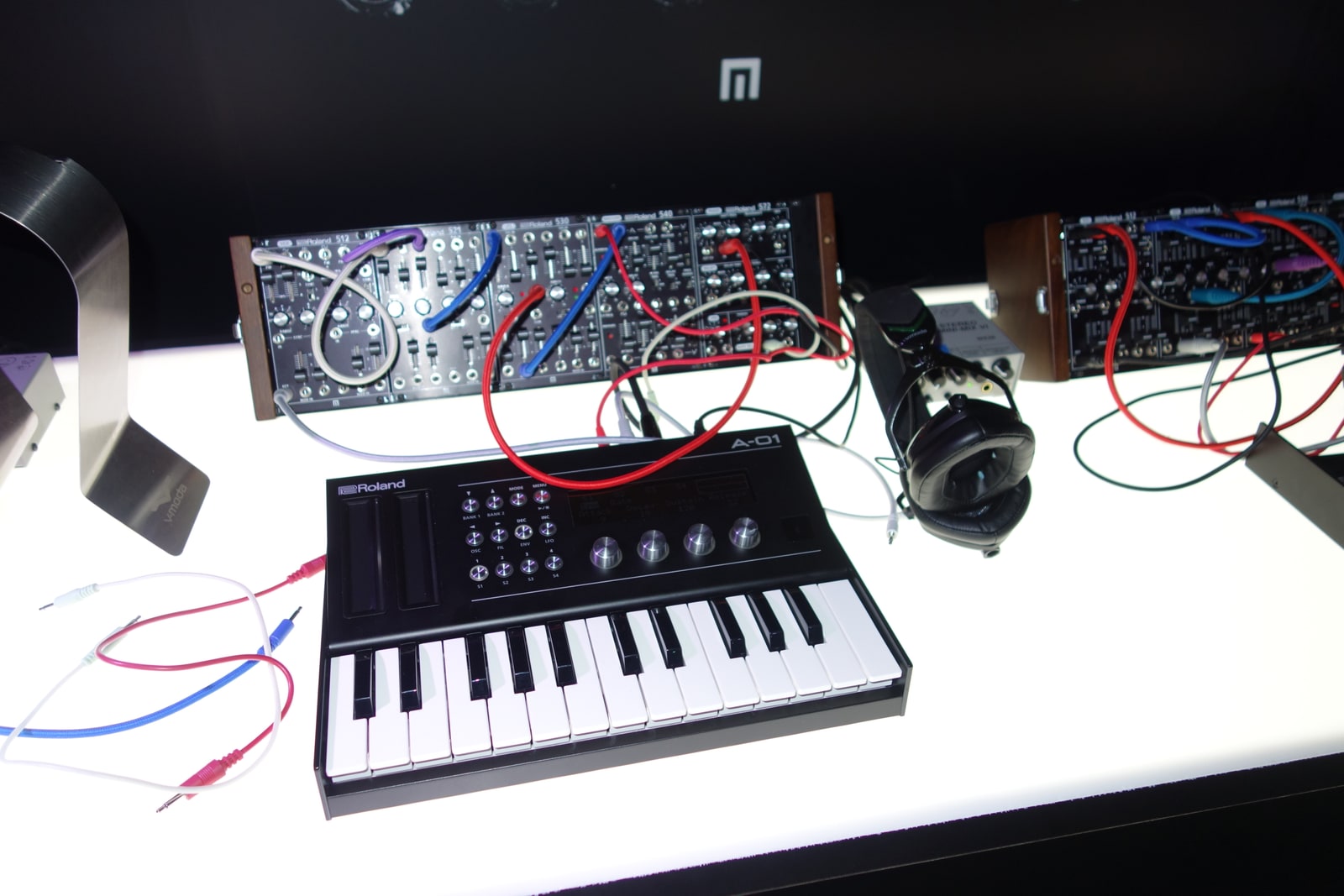
The real archive photograph accompanying this article was taken at NAMM in January 2016. It does not show these October 2026 products or establish their behavior. The news is a new pair of compact creative tools; their value still depends on a musician’s work. Voices, layers, steps and connections are useful information when each retains its own meaning.
Source notes: 1, 2, 3. Original editorial examples and interpretations are identified separately.
Sources & Methods
Prepared October 20 from the complete Roland announcement and both complete product pages, including specification tables. The release’s ambiguous description of the older architecture is not used; capacity figures are attributed to current product specifications. The film cue, working distinctions, sequence arithmetic and evaluation approach are original editorial explanation. No instrument was played, audio compared, software installed or vendor claim independently benchmarked. The photograph is explicitly historical context, not new-product photography.
- Roland: October 20 announcement — Primary manufacturer release; complete body read; official index dated October 20
- Roland: JUPITER-08 product specifications — Primary product page; complete feature description and specification table read
- Roland: n/vision product specifications — Primary product page; complete feature description and load-dependent polyphony qualification read