
A new industrial controller, not a faster desktop processor
Renesas introduced RX74M and RX74N on October 22. The company calls these the first members of its RX microcontroller family made on a 22nm process with embedded MRAM, and says they are available. That is the manufacturer’s launch statement, not a distributor-stock check. It positions RX74M toward factory control and RX74N across broader industrial equipment.
The useful way to approach this news is to ask what a machine must keep doing while other work arrives. A controller may need to handle a command, update an output and retain a changed setting. Those demands compete for attention, but they do not all have the same consequences when delayed. Finishing a less important task early cannot compensate for missing the important one.
That makes this a story about coordination rather than a league table of chip speeds. Our assessment separates three questions: can the required work finish on time, can a software change leave the machine recoverable, and does integration simplify the complete design? The announcement makes these questions worth investigating; it does not answer them for every application.
Source notes: 1. Original editorial examples and interpretations are identified separately.
Real-time performance means meeting the deadline that matters
The RX74M page lists an RXv3e core reaching 600MHz and a register-bank save function intended to shorten interrupt response. It also lists 300MHz and 480MHz variants. Treat these as configurations within a family, not a promise that every ordering code runs at the maximum. A clock frequency alone does not measure a finished control loop.
Consider an invented planning example, not a Renesas benchmark. A task has a 100-microsecond deadline. Suppose computation takes 35 microseconds, waiting takes 25 and communication takes 15: the total is 75, leaving 25. If computation occasionally takes 80 instead, the same other stages bring the total to 120. That instance misses the deadline by 20, even if most runs are fast.
The lesson is not that this controller has those timings; none were measured here. It is that an evaluation needs to retain the difficult cases rather than hide them inside an attractive average. Ask what happens when important tasks overlap, when an interruption arrives at an awkward moment and when the workload grows. Peak capability is a starting condition, not the completed timing argument.
Source notes: 2. Original editorial examples and interpretations are identified separately.
MRAM changes the write operation—not the whole update problem
Renesas’s engineering explanation says MRAM holds nonvolatile code without an erase operation before writing. The RX74M feature page describes up to 1MB of dual-bank code MRAM and 48KB of data MRAM, alongside SRAM. Those are distinct stores with different roles; the largest number should not be treated as one interchangeable pool of application space.
Removing a preliminary operation can simplify a part of an update. It does not logically establish that every multi-step software replacement is indivisible, authenticated or recoverable after interruption. Those are separate properties of the update design. Keeping bytes without power and deciding which complete version is trustworthy are different questions; persistent storage does not make an incomplete change meaningful.
For a proposed design review, draw the interruption points: before writing, during the transfer, before accepting the new version and after restarting. At each point, identify which valid program can take control and which settings it expects. Dual-bank storage may be useful material for that design, but this article has not demonstrated automatic rollback. The interesting benefit is a different engineering option, not permission to stop testing recovery.
Source notes: 2, 4. Original editorial examples and interpretations are identified separately.
An integrated network controller is not the entire network
The product descriptions distinguish RX74M’s EtherCAT and TSN-capable Ethernet integration from RX74N’s broader connected-industrial positioning. RX74N lists one Ethernet channel and no EtherCAT channel in its parameter table. Capabilities also vary by ordering code. Choosing the right part therefore requires reading the actual configuration, not transferring the richest family-level feature list onto every device.
Our interpretation is that integration moves an engineering boundary. Fewer separate devices can mean fewer interfaces to coordinate on a board, but combining functions also makes their shared workload important. A clear evaluation should ask what control work continues while the communication side is busy, and how the system behaves when a connection is unavailable.
A network feature inside one chip is not evidence that all attached equipment shares the same timing behavior or configuration. Document the complete path a command takes and the conditions under which its result must arrive. That makes a comparison useful: does this configuration reduce the difficult parts of the intended system, or merely concentrate them? No complete network was assembled or validated for this article.
Source notes: 2, 3. Original editorial examples and interpretations are identified separately.
Security hardware is a foundation, not a compliance certificate
Renesas’s technical blog describes Protect Zone as a way to separate secure and non-secure execution, and RSIP as providing hardware-based key management and cryptographic support. These are advertised building blocks. The page’s broader security assurances are the manufacturer’s positioning, not findings from a security assessment conducted by Lumacta.
The practical question is what the finished product permits, not simply whether the silicon includes a named function. Which code may change a trusted setting? Who can authorize an update? What happens when access is lost, a key must be replaced or the product needs a supported repair? Hardware capabilities become valuable when the surrounding decisions are explicit and can be checked.
It would therefore be premature to read this launch as proof that an end product satisfies a regulation, defeats every attack or has a validated post-quantum deployment. We make none of those claims. For an engineering evaluation, retain the assumptions, the responsibilities and the evidence needed to test them. A more capable component can support the work; it cannot substitute for the work.
Source notes: 4. Original editorial examples and interpretations are identified separately.
The strongest case may be a controller that is easier to maintain
The engineering blog also introduces FSP support for these RX devices, with drivers, sample projects and middleware spanning communication, security and storage. That gives a team software material to evaluate alongside the chip. It does not establish that an existing application can move unchanged or that development time falls by a measured amount.
Our editorial verdict is to judge the transition with one representative piece of useful work, then add the conditions most likely to disturb it. Record the deadline margin, interruption recovery and effort needed to understand a failure. Compare those results with the design already in use. A replacement makes sense when it resolves an actual constraint without creating a less manageable one—not merely because a specification is newer.
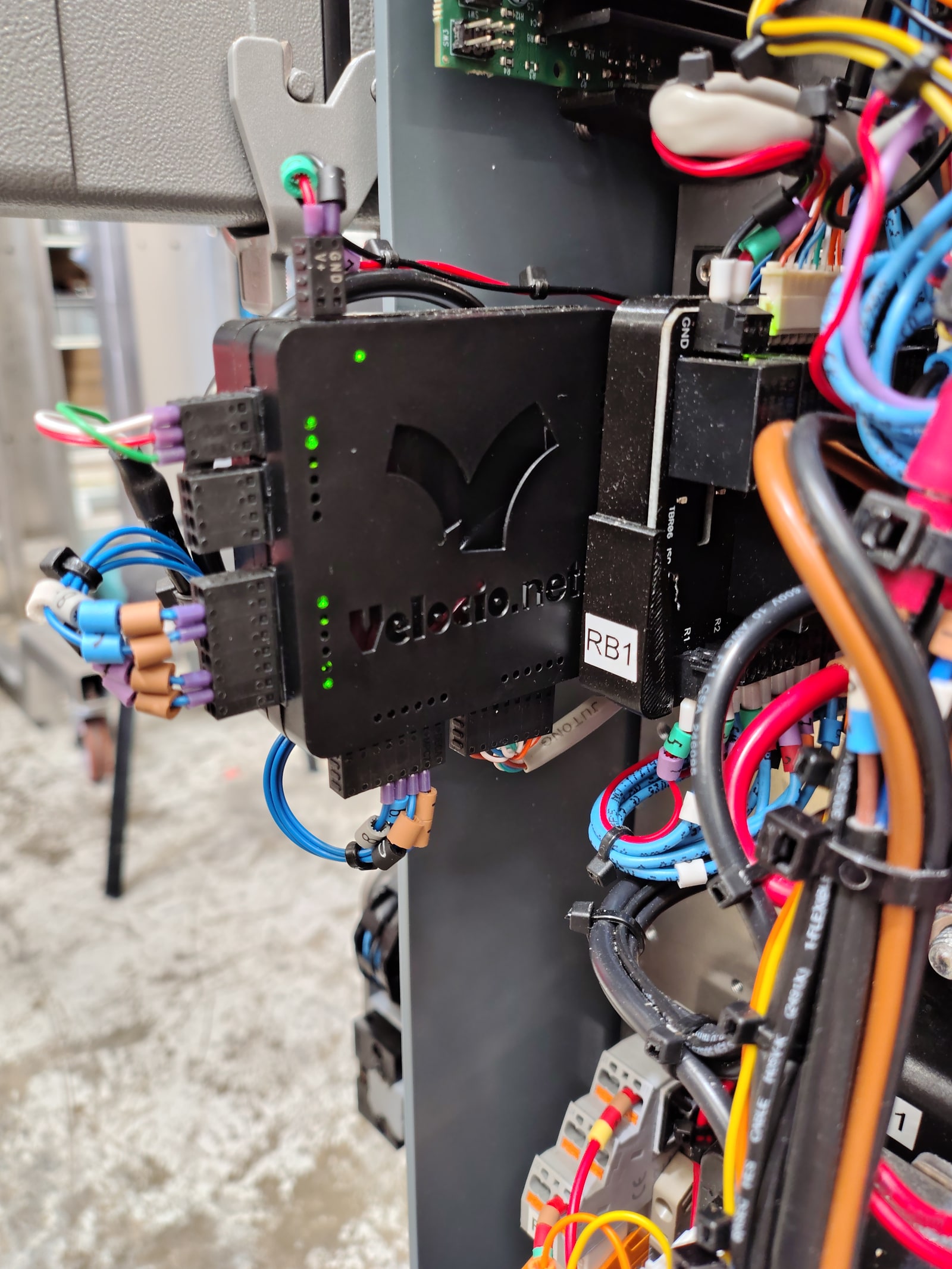
The real photograph accompanying this article shows an embedded controller in a small machine, photographed in April 2026. It is context, not an RX74M or RX74N product photograph. The substantive news is a new combination of memory, processing and connections. Its lasting importance will depend on whether engineers can turn that combination into machines whose behavior remains understandable after years of changes.
Source notes: 4. Original editorial examples and interpretations are identified separately.
Sources & Methods
Prepared October 23 from the complete October 22 manufacturer release and engineering blog, with both product-page feature descriptions, parameter tables and configuration qualifications read. Product capabilities and availability remain attributed manufacturer claims. The 100-microsecond schedule is an invented arithmetic example, not a benchmark or safety recommendation. No hardware was installed, firmware executed, update interrupted, network tested, cryptography audited, legal compliance established or price verified. Ambiguous cross-page peripheral values are omitted rather than reconciled by guess. The accompanying camera photograph is explicitly dated contextual archive material.
- Renesas: October 22 announcement — Primary manufacturer announcement; complete body read
- Renesas: RX74M configuration — Primary product page; features, description, parameters and variant qualifications read
- Renesas: RX74N configuration — Primary product page; features, description, parameters and variant qualifications read
- Renesas: industrial-design explanation — Primary engineering blog; complete body read