
A roadmap, not a product certificate
NIST IR 8615 records the January 26 Sustainable Hardware Security workshop. Its September publication identifies priorities for future standards and practice; it does not certify the equipment on your desk. NIST’s announcement establishes that distinction in scope.
The report’s summary connects common assurance frameworks with traceability, supplier incentives, verification tools and workforce skills. In sections 3.2–3.3, the mechanisms include cryptographic identities, software bills of materials, attestation and verification. These are complementary forms of evidence, not interchangeable labels. Read the relevant report page.
Three questions that a “secure hardware” claim must not merge
An SBOM describes software components and their relationships; that is the role set out in CISA’s reference material. Remote attestation is different: evidence from a target environment is appraised by a verifier, and another party uses the result to make a decision. RFC 9334 describes those roles.
| Question | Useful evidence to request | What it does not settle |
|---|---|---|
| What software is included? | A version-specific SBOM, with its producer, scope and date. | Whether the delivered unit is genuine, patched or currently running that software. |
| Which device produced this evidence? | A device-bound identity and an explanation of who vouches for it. | Whether its firmware is acceptable for your intended use. |
| What state was measured? | Attestation evidence, reference values and the verifier’s decision rules. | Every possible vulnerability, or an indefinite guarantee after the measurement. |
The limits in this table are our interpretation of the different evidence types. An identity or attestation mechanism is useful only within its documented scope and trust assumptions.
Worked example: buying a network gateway
Hypothetical example, not a reported incident. A small studio needs a gateway between editing workstations and a shared storage system. A supplier provides an SBOM for firmware release A. The studio should first ask whether that inventory belongs to the release actually installed on the delivered unit. A neatly formatted document for another version would not answer its question.
Next, suppose the gateway supplies signed evidence about its firmware. The studio still needs to know what was measured, which signing identity is trusted and which reference release is allowed. A signature should not be read as the sentence “all software on this device is safe”. Those are different claims.
Finally, imagine the supplier demonstrates one successful check on Monday, but the gateway is updated on Friday. Our practical question is whether the evidence still describes the current state. RFC 9334 treats freshness explicitly; a historical result is not automatically a current assurance.
A short checklist for the purchasing conversation
This is a starting point for discussion, not a security audit or a mandatory NIST control set:
- Bind the evidence to the purchase. Ask which unit, component and firmware release it covers.
- Ask who can validate it. Request the verification procedure and the party responsible for maintaining acceptable reference values.
- Test the failure story. Ask what happens when evidence is missing, outdated or rejected, and who is notified.
- Plan the next update. Ask how the inventory and accepted state change when firmware is replaced.
- Record exclusions. Ask which components or threats are outside the assessment, and which require separate evaluation.
A useful follow-up is a demonstration with an intentionally outdated test fixture in the supplier’s own environment. That is a proposed acceptance exercise, not something we have performed. Its purpose would be to check whether an incorrect state is detected, rather than simply collecting another “pass” screenshot.
Our conclusion: buy an evidence process, not a badge
For a buyer, the valuable outcome is an answer that can be checked again after delivery. An inventory can help identify affected software; identity can bind a claim to a device; attestation can support a scoped decision about measured state. The purchasing error is to ask one of them to do all three jobs.
NIST’s roadmap gives this problem a standards context. Our recommendation is narrower: put the evidence, its limits and the person responsible for maintaining it into the conversation before treating “secure hardware” as a completed feature.
Sources & Methods
Document analysis, not a hardware assessment. The NIST summary on printed pages 15–16 was checked against the full PDF. CISA supplies the software-inventory definition; RFC 9334 supplies the attestation architecture. The gateway example and purchasing questions are LUMACTA’s editorial synthesis, not a NIST case study or compliance checklist. No device was tested and no expert was interviewed.
- NIST publication notice — Report date and workshop context
- NIST IR 8615, printed pages 15–16 — Recommendations and correction
- CISA SBOM resources — Software-inventory definition
- IETF RFC 9334 — Sections 4, 8 and 10: evidence, appraisal and freshness
- NIST CSRC — IR 8615 final publication — official report record and DOI
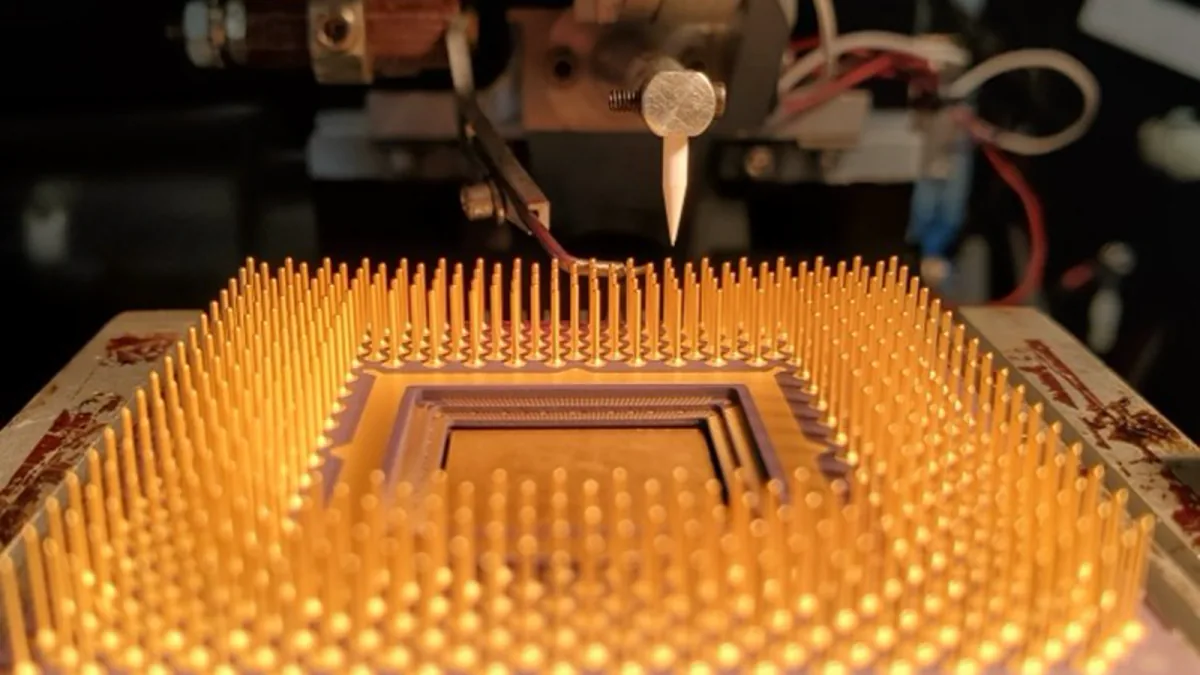
- NIST — Fabricated Semiconductor Chip — context image and editorial-use terms