
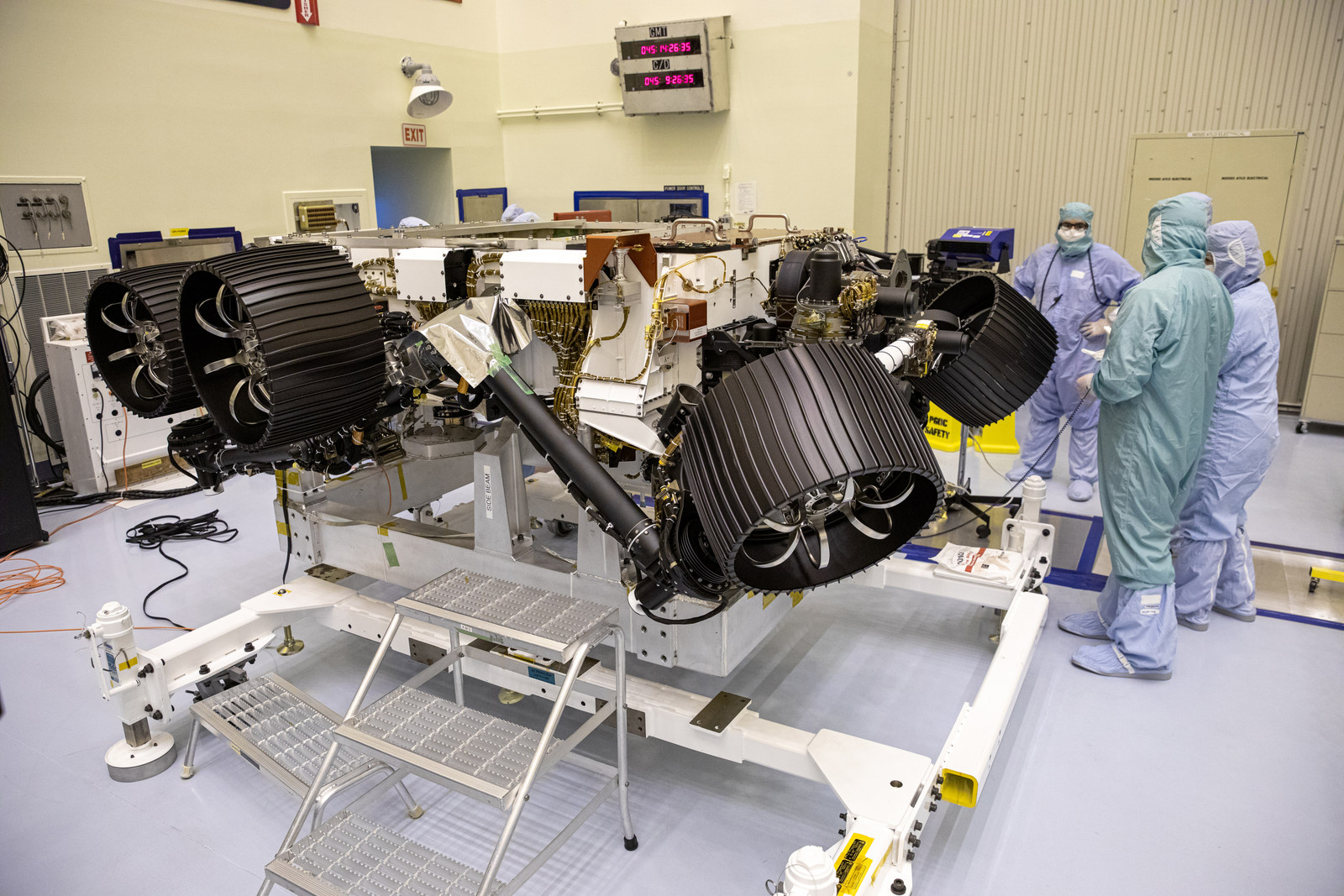
Two faults, two recovery paths
NASA reported on November 19 that Perseverance and Mars Odyssey had paused science work. Perseverance remains in contact with Earth. Odyssey’s relay service is offline, and NASA estimates one to two months of fuel for thruster-only pointing if its wheel cannot be recovered.
Perseverance’s primary UHF radio fault appeared October 30. Diagnostics later showed roughly half the expected power from the backup. The team paused both radios, and the rover is using its direct X-band connection.
Follow the data path
NASA’s Mars Relay Network documentation explains the architecture: surface vehicles send their larger science returns through orbiters, which forward them to Earth. Direct links also carry commands and telemetry. The orbiters can support larger antennas and power systems than a rover, while relay opportunities vary with the available spacecraft and the length of each pass.
For Perseverance, the direct link keeps engineers in touch at a lower data rate. They can prioritize the information needed to choose the next safe test while working to restore the larger science pipeline.
It also means that counting working spacecraft is a weak substitute for describing a service. Ask which radio can reach which partner, when that partner can receive it, and how the information reaches the ground. A replacement path only solves the part of the problem that it can actually carry.
Capacity is a different question from contact
NASA describes the Deep Space Network as a system for commanding spacecraft, tracking them and monitoring their health, as well as supporting science. Its complexes in California, Spain and Australia allow receiving responsibility to move around Earth as the planet rotates. That ground infrastructure is part of the communications chain, alongside the spacecraft equipment.
For a simple illustration, suppose an engineering team has a fixed daily allowance of data and a diagnostic package takes half of it. The remaining allowance must cover everything else the team chooses to return. Doubling the number of desired observations does not enlarge that allowance. This is an illustration of budgeting, not an estimate of either Mars mission’s present transmission rate.
For readers following an image archive or a science dataset, the useful question is therefore what an interruption represents. Collection, storage, transmission and publication are different steps. A gap in a public feed alone cannot tell you which step changed. The mission’s dated operational explanation supplies that missing context.
Source notes: 3.
Pointing with a limited workaround
NASA’s separate technical explanation of reaction wheels describes electrically driven flywheels that store angular momentum. Changing a wheel’s speed changes how the spacecraft points. This provides a way to turn and hold an orientation using electrical power, with thrusters serving a different part of the spacecraft’s control system.
Odyssey was in safe mode November 4–6. One reaction wheel had already failed in 2013. The second faulty wheel moved during a test, and the team is still checking whether it can return to use.
The same discipline applies to a promising component test. A part responding to a command is evidence worth reporting. Sustained, predictable performance under the conditions needed for routine work answers a broader question. An engineering update should say which of those milestones has been demonstrated.
Separate reporting from replication
Space.com reported both problems on November 20, based on NASA’s update. For Perseverance, the next useful sign is a dependable UHF path to an orbiter. Odyssey’s mission team is aiming to return to both science and relay work.
Keep three dates beside the story: when a problem occurred, when it was disclosed and when a reader last checked the status. Those dates can differ substantially. A fresh report can describe an older fault, and an older report can remain accurate while offering no evidence that the latest planned test succeeded.
Another useful check is to identify the noun behind a reassuring headline. Contact, command acceptance, stable pointing, instrument operation and science return describe different results. Treat a claim about one as a claim about that result, then look for the next piece of evidence rather than silently promoting it to a complete recovery.
Source notes: 5.
What a useful next update would show
The next useful report would identify what was tested, the result and which operations can safely resume. For communications, that means describing the restored path and the work it can support. For pointing, it means explaining the operating configuration and the remaining constraints. A date matters most when it is connected to those measurable steps.
The practical lesson reaches beyond these two missions: a resilient system needs a clear definition of its degraded service. A backup that preserves contact can be extremely valuable while still imposing a costly pause. The evidence of recovery is the return of useful, sustainable work, with the limitations stated alongside it.
Sources & Methods
Primary mission and engineering records were read alongside a separate editorial report. The data-allowance example and recovery checklist are Lumacta analysis. The original photograph, metadata and factual editorial reuse guidance were checked.
- NASA’s mission update — Primary disclosure, November 19, 2026; publication date differs from the fault dates.
- Mars Relay Network — Primary architecture and relay documentation; historical table values are not used as current service measurements.
- Deep Space Network — Primary description of ground services and three-complex architecture.
- How reaction wheels work — Primary NASA engineering explanation; Roman-specific specifications are not transferred to Odyssey.
- Space.com’s mission report — Independent editorial coverage, November 20; the fault account is attributed to NASA, not a separate telemetry measurement.
- Archive photograph record — NASA/Kim Shiflett. Caption, filename and EXIF identify February 14, 2020.
- NASA media-use guidance — Factual editorial use with attribution and no implied endorsement; promotional use remains separate.