
Earth departure is complete
NASA reported on November 9 that both ESCAPADE spacecraft successfully completed powered Earth flybys, on November 7 and 9, and are heading toward Mars. Orbit insertion is planned for September 7 and 9, 2027; science operations are expected to begin in June 2028. Those are future milestones, separate from the departure now completed.
NASA says it is the first time the agency has used powered Earth flybys to send spacecraft toward Mars.
Source notes: 1.
Gravity with an engine burn
The maneuver combined Earth’s gravitational assist with an engine firing near closest approach. NASA’s preflight explanation called for roughly nine-minute trans-Mars injection burns. Rather than treating the planet as a passive turning point, the spacecraft used their propulsion during the encounter to gain the extra velocity needed for the next leg.
That is why the engine firing belongs in the story as much as the flyby. NASA’s explanation identified the powered encounter as an Oberth maneuver and contrasted it with earlier Mars trips launched during favorable planetary alignment. Its November 2 account was a plan, not evidence of completion; the subsequent mission report supplies that confirmation. The preflight account also said the team would assess the resulting trajectory over the following days and use later correction maneuvers. A successful departure therefore begins another period of navigation work rather than eliminating it.
Source notes: 2.
What the long detour bought
Advanced Space, which designed the trajectory, explains that a missed late-2024 transfer opportunity prompted an alternative route for the November 2025 launch. The spacecraft could leave Earth, spend time near the Sun–Earth L2 region, then return for a powered flyby when a useful Mars departure geometry became available. Its design account describes a launch-and-loiter strategy rather than an immediate transfer.
The practical gain is a different place to absorb schedule pressure. A spacecraft need not be ready on the exact day required by a direct Mars departure, but it still needs a workable later encounter. That distinction keeps the idea useful without turning it into a claim that planetary geometry no longer matters. Advanced Space is a mission participant, so its account establishes the design reasoning, rather than independently validating the mission’s performance.
The design changes the relationship between launch and departure. It creates scheduling freedom for a mission built around that architecture, without establishing the same performance for a differently sized or equipped payload.
Source notes: 3.
An earlier independent check explains the risk
Independent reporting helps put that flexibility in perspective. In January, Space.com’s Leonard David interviewed principal investigator Rob Lillis and mission designer Jeffrey Parker about the loiter strategy. Lillis acknowledged the additional wear associated with a longer flight, while Parker described the importance of firing the engines at the right time during the Earth encounter. A missed departure could mean waiting for another opportunity roughly two years later.
The same report traced an enabling engineering choice: the mission had moved from ion propulsion to chemical propulsion and larger propellant tanks, opening different trajectory options. Those interviews document the trade-off the team accepted before the flybys. They are not a second, independent confirmation that this week’s burns succeeded. Read alongside NASA’s new report, they make the achievement more concrete: a previously identified critical step has now been reported complete.
Source notes: 4.
The spacecraft were already working
This was not a year in which the vehicles simply waited to be switched on. Rocket Lab announced completion of commissioning on February 26, 2026, saying that the two spacecraft, Blue and Gold, had been checked out near L2 and that operational control was being prepared for handover to UC Berkeley’s Space Sciences Laboratory. It had designed, built and commissioned the Explorer-class spacecraft under contract to the laboratory.
The company also described instrument testing and early heliophysics observations in Earth’s magnetotail during the loiter period. That is a different scientific setting from the intended Mars investigation. Commissioning establishes an earlier stage of readiness; it should not be mistaken for completion of the eventual science mission. Rocket Lab’s statement supplies useful hardware and operations history, with the perspective of the spacecraft manufacturer clearly attached.
Source notes: 6.
Why Mars needs two observing positions
The scientific target is atmospheric escape. NASA’s mission documentation describes Mars’ magnetic environment as a combination of remnant crustal fields and fields induced in the upper atmosphere. The twins will measure the interaction with the solar wind. Two observing positions help distinguish changes over time from differences between locations, instead of asking a single measurement to resolve both. The objective is to connect measured escape processes with the longer history of Mars losing its once thicker atmosphere.
The first campaign puts the spacecraft along nearly the same orbit, one following the other. The second separates their paths so they can examine different regions simultaneously. NASA’s flight outline also explains the gap after arrival: each vehicle must brake into a capture orbit, reduce and adjust that orbit, pass through a solar-conjunction interruption in communications, then finish moving into the science formation. Reaching Mars and collecting the planned coordinated observations are consequently different achievements. That sequence explains why an arrival headline should not be read as the start of the main observing campaign.
Source notes: 5.
Our assessment: judge the route by what follows
The most interesting lesson is about where a project places its constraints. Flexibility is valuable when it lets good work proceed despite a missed deadline. It becomes much less convincing if the price is hidden in a vague promise of later results. The right editorial response is to credit a demonstrated step while keeping the intended outcome visible.
For this mission, we would judge the next stages by observable progress: whether navigation updates continue to support the encounter, whether the arrival maneuvers achieve their intended orbits, and whether the resulting measurements answer the scientific questions. These are criteria for assessing future reports, not predictions that any step will fail. The cleverness of a route earns attention; the evidence it eventually enables earns the mission’s lasting value.
Sources & Methods
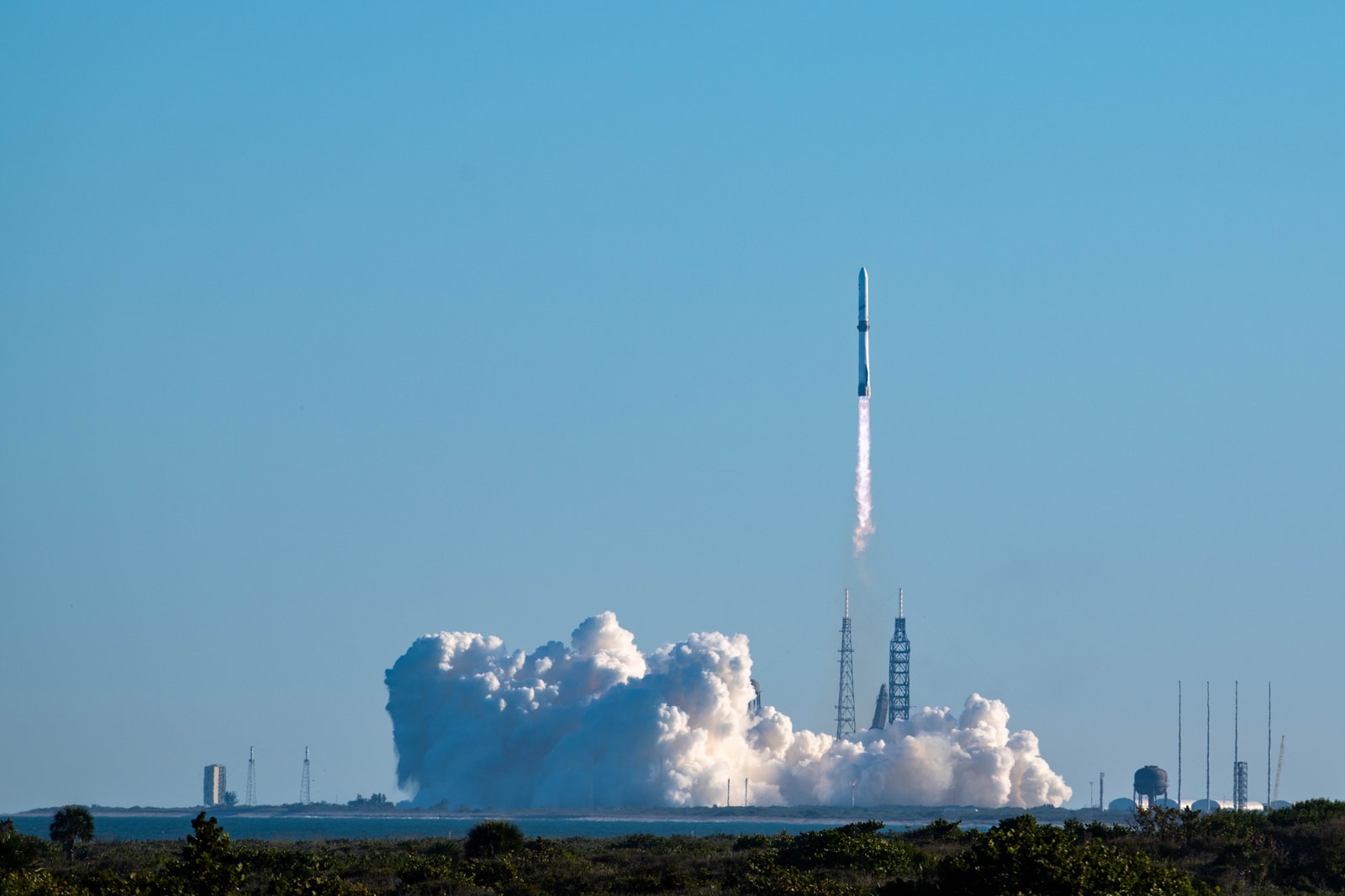
Prepared November 10, 2026 from the complete NASA flight report and mission documentation, participant design and commissioning accounts, and Space.com’s January interviews. NASA supplies the current flight-status confirmation; the independent reporting explains the earlier trade-off. The final section is our editorial assessment. Photograph: actual 2025 launch archive, not an image of the 2026 flybys.
- NASA flyby completion report — Primary mission update; full body read
- NASA preflight maneuver explanation — Primary planning context; full body read
- Advanced Space trajectory design — Mission participant; design account read
- Space.com mission interviews — Independent reporting; full body read
- NASA mission architecture — Primary science and flight documentation read
- Rocket Lab commissioning report — Primary manufacturer statement; full body read
- Official launch photograph — Primary image record; date and creator read
- DVIDS reuse conditions — Primary rights guidance read