
An observing pause becomes a mission ending
NASA announced on November 17 that NICER’s science operations have ended. Observations stopped in June 2025 after the space-station telescope lost sideways movement; engineers suspect an internal motor failure. Teams now plan to finish its eight-year archive and decommission and detach the instrument. The announcement gives no removal date.
NICER’s closure separates two responsibilities. Researchers have lost an instrument for requesting new exposures, while the archive lets them revisit existing evidence. The engineering decision changes the observing programme. The quality of the stored measurements and their documentation will shape what later researchers can check.
Source notes: 1.
Why a pointing motor matters to an X-ray telescope
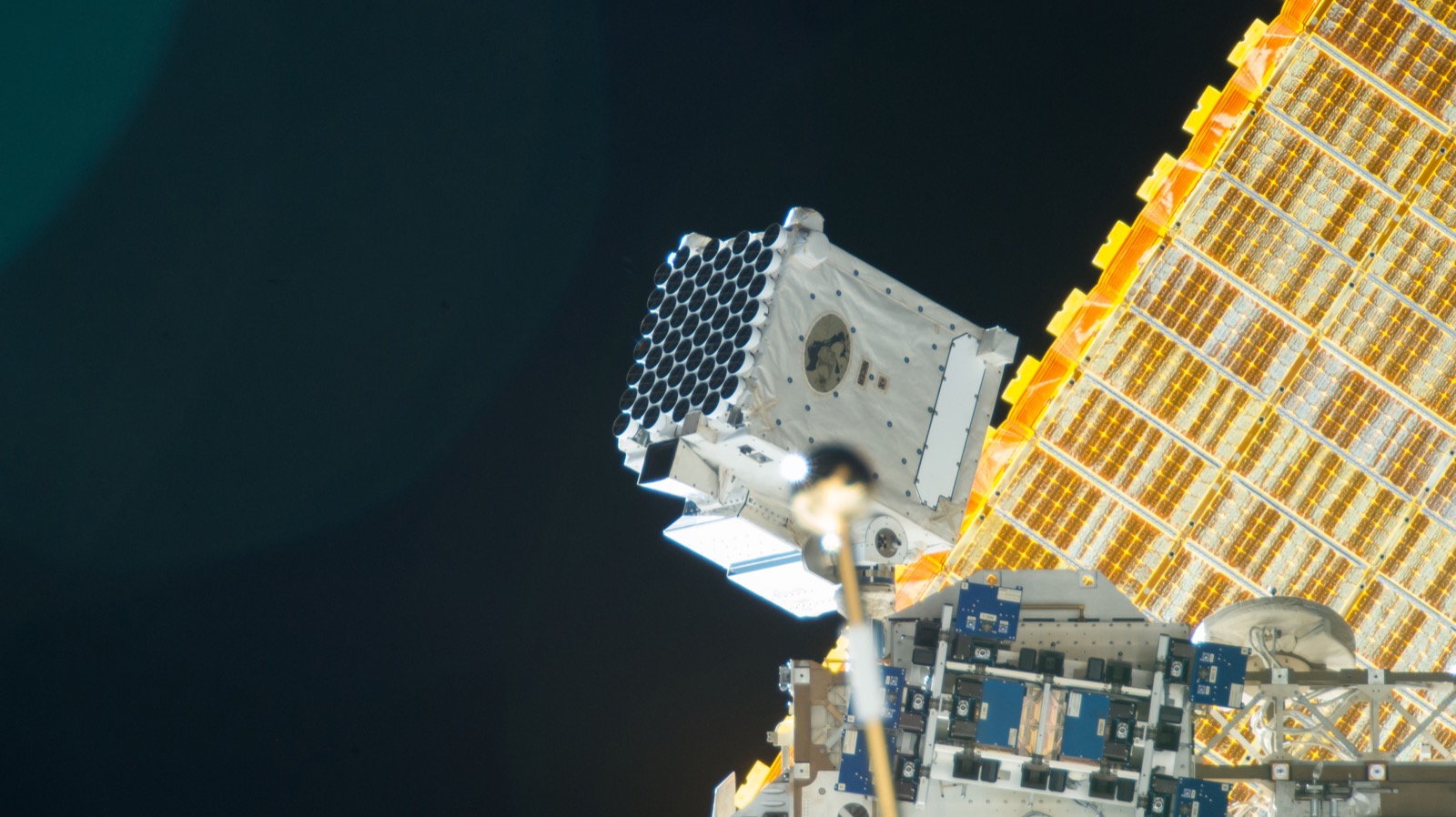
NICER is a collection of 56 aligned X-ray concentrators and detectors. Its instrument records individual events with their arrival times and energies. A star-tracker-based pointing system keeps celestial targets in view. The mission guide also describes how particles and detector electronics can produce events that must be screened out. Recording a signal is only the beginning of deciding which signal belongs to the source.
A functioning detector cannot compensate for a target that it cannot follow. Think of trying to measure the rhythm of a distant flashing lamp through a narrow tube while your platform moves. Accurate timing helps only while the lamp remains inside the tube. That is why an apparently modest mechanical fault can stop an experiment built around sophisticated detectors.
NICER had previously faced sunlight entering through damaged thermal shields. A NASA repair account describes how the shields reject sunlight while admitting X-rays. The later loss of pointing motion affected another part of this observing chain. Keeping that sequence clear helps explain what actually stopped the mission.
The star’s size is inferred from a changing signal
Neutron-star radii matter because their relationship with mass tests how extremely compressed matter supports itself against gravity. In his 2026 review, University of Maryland astrophysicist M. Coleman Miller explains how NICER uses rotating hot regions on a star’s surface. Their changing X-ray signal carries information about the star’s dimensions and about gravity bending the light on its way out.
The resulting radius is a model-based estimate. Researchers model the emitting regions, viewing angle and other contributions to the signal, then compare predicted waveforms with observations. Miller’s review argues that the systematic effects explored so far have generally had a small effect on inferred radii when the models fit the observations adequately. That assessment applies to tested models that fit the measurements.
Source notes: 4.
A useful archive must allow the interpretation to be challenged
A separate study by Tolga Güver and colleagues, revised in January 2026 and accepted by the Astrophysical Journal, offers a more cautionary methodological perspective. The authors examined how many independent features can actually be extracted from pulse profiles and complementary spectra. They warn that a complicated surface model can contain more adjustable quantities than the observations can reliably constrain. They also argue that pulsed nonthermal emission needs explicit treatment.
These papers address overlapping scientific questions with different emphases. Their relevance to the shutdown is that a preserved measurement can support later scrutiny of the conclusions drawn from it. A convincing fit should be tested against plausible alternatives. The complexity of a model should reflect the information available in the observations.
For example, an analysis might attribute a faint component to emission from the star, while another treats it as background. The two could agree on many recorded events while disagreeing on what they imply for the radius. A useful reanalysis would identify which assumption made that difference and test it against independent information. Simply announcing a more precise number would leave that crucial step hidden.
What survives is more useful than a collection of finished pictures
HEASARC provides NICER observation searches and direct data retrieval, together with calibration records and analysis software. Its archive documentation distinguishes observations from the processing and calibration needed to use them. The mission guide likewise describes cleaning detector events before analysis, including checks on residual backgrounds.
That distinction matters to anyone assessing a later discovery made with the archive. A new publication should explain which observations it used, how they were processed and what changed in the interpretation. An improved background estimate can affect a weak signal. A second instrument can help distinguish explanations that fit one data set similarly well. Preserving the route from recorded events to a published result makes such comparisons possible.
The next milestone is the final scientific record
The practical milestones now are the archive’s final documentation and the instrument’s decommissioning plan. Removing hardware is an engineering operation, while maintaining usable observations is a scientific obligation. Researchers need enough information to reproduce an analysis without relying on the original team’s memory.
For readers, the useful question about a future NICER paper will be what it establishes beyond the previous analysis. Does it test a different source of background, compare another observatory or show that a conclusion survives a different model? The end of observing narrows the supply of new measurements. It also makes the care taken with the measurements already in hand more consequential.
Sources & Methods
Lumacta read NASA’s dated mission update, instrument and archive documentation, and contrasting scientific assessments. The shutdown announcement is NASA’s primary report; the research papers independently assess the science and its limits, not the cause of the hardware fault. The photograph is explicitly archival. Prepared with AI assistance.
- NASA’s November 17 NICER mission update — Primary dated mission announcement
- NICER instrument and data-processing guide — Primary technical documentation
- NASA’s earlier NICER thermal-shield repair account — Historical primary engineering explanation
- Miller’s review of NICER radius measurements — Scientific review published in Annual Review of Nuclear and Particle Science
- Güver and colleagues on the information in pulse profiles — Independent primary methodological study accepted by the Astrophysical Journal
- HEASARC’s NICER archive and calibration access — Primary archive documentation
- NASA’s original NICER photograph and capture record — Primary photographic source and credit