
An approaching flight test, not an orbital cloud service
Google says its first Project Suncatcher orbital test is approaching. The September 24 update describes a prototype developed with Planet for the upcoming Transporter-18 mission. It is intended to measure how Tensor Processing Units, Google’s AI accelerators, cope with spaceflight and the orbital environment. This is a planned test, not evidence that commercial AI workloads are already running on this satellite.
The project itself is older: Google introduced Suncatcher in November 2025. The new development is the move towards flight measurements. For readers following the programme, that distinction prevents a launch preparation story from becoming a claim that a new kind of data centre has already arrived.
Lumacta’s reading is that the experiment is valuable even if it finds limitations. Discovering the operating envelope of a real payload is a more useful next step than assuming that a promising architecture will work at every scale.
Source notes: 1, 2. Analysis and proposed examples are identified in the text.
Space has no breeze to carry the heat away
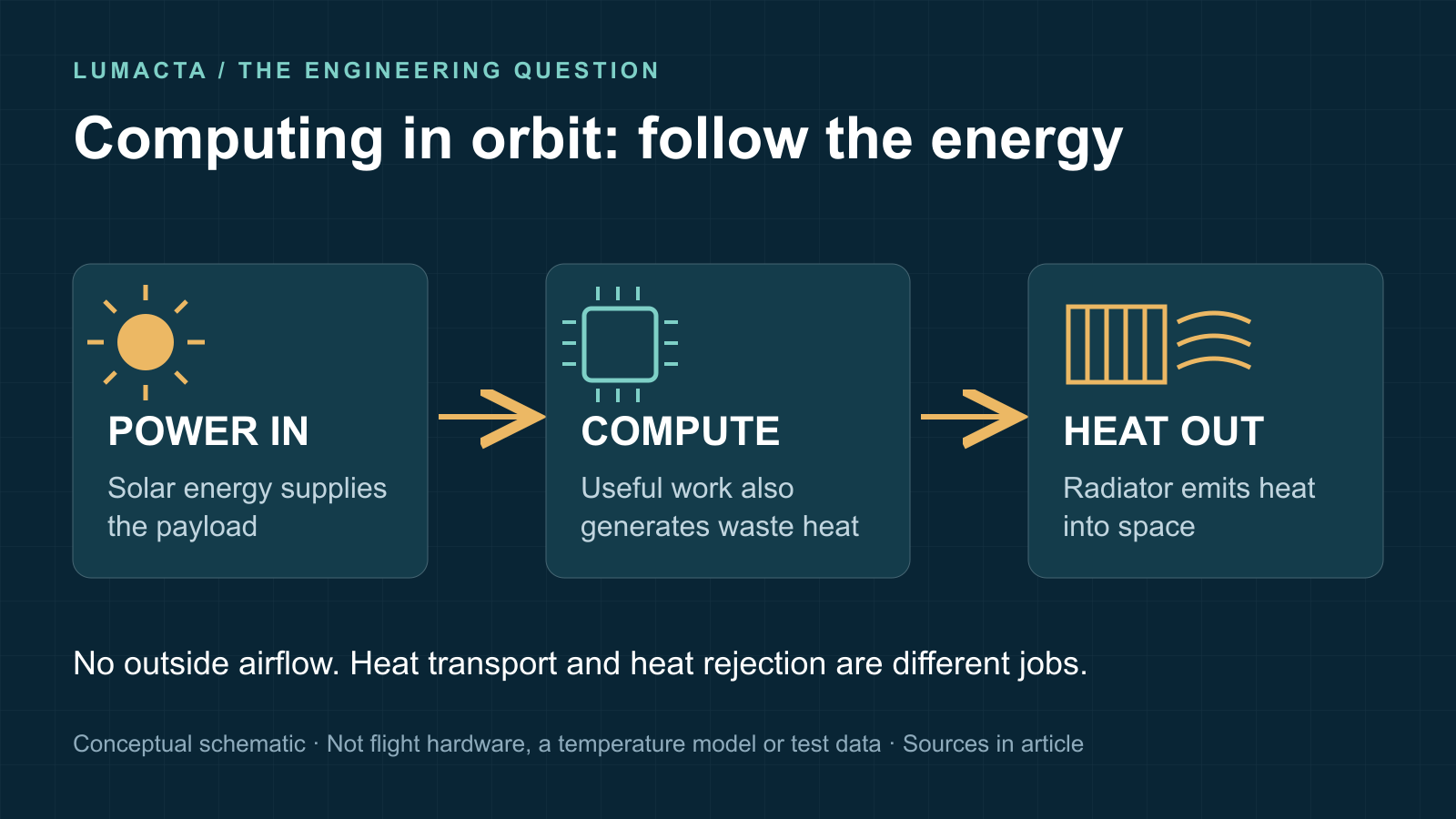
NASA’s thermal-control reference explains the basic constraint: a spacecraft in vacuum cannot shed heat to surrounding air by convection. Heat can move through its structures and thermal hardware, but rejection to the external environment depends on radiation. Radiator area, orientation, surface properties and incoming sunlight therefore belong in the computing design.
A heat pipe and a radiator do different jobs. The first helps move heat away from a concentrated source; the second provides a surface that can emit that energy. Moving heat away from a processor is not the same as getting it off the spacecraft. A cold-looking background in a space illustration does not remove this engineering problem.
Our interpretation is that usable computing power must be judged over sustained operation. If a payload has to pause to stay within temperature limits, its peak chip specification will not describe the amount of work it can complete over an orbit. This is a performance question we would ask of flight results, not a reported failure of Suncatcher.
Source notes: 3. Analysis and proposed examples are identified in the text.
A radiation test is evidence with boundaries
Google reports ground vibration and radiation testing and describes heat-pipe and radiator development. The June 2026 revision of the project’s preprint records improved radiation-test methods. These are useful engineering inputs, but neither a laboratory test nor a preprint is a substitute for operating the complete satellite in orbit.
The distinction between cumulative radiation exposure and individual errors is important to our assessment. A processor that remains functional can still encounter an error that a workload must detect and recover from. “Still running” and “returned the correct result” should not be merged into one success measure.
A useful flight report would therefore state the workload, operating duration, error-detection method and recovery behaviour alongside hardware status. It should also distinguish a planned restart from an unexpected interruption. We have not inspected the test hardware, raw logs or an independent replication of Google’s experiments.
Source notes: 1, 4. Analysis and proposed examples are identified in the text.
Several working chips still need to behave like one system
The earlier Google Research proposal calls for closely spaced satellites connected by optical links. It reported a bench demonstration of 800 gigabits per second in each direction with a transceiver pair. That was a laboratory result, not an orbital networking measurement or the aggregate performance of a constellation.
For an analogy, imagine dividing a large editing job between several fast workstations. If they must constantly wait for shared files, adding faster processors may leave the real bottleneck untouched. The exact requirements of distributed AI differ, but the systems lesson is similar: communication has to keep pace with the chosen workload.
The evidence we would want next is sustained useful work across connected hardware, including link interruptions and recovery. A link that briefly reaches its target rate and a system that reliably completes a distributed job answer different questions. Neither should stand in for the other in a purchasing or infrastructure decision.
Source notes: 2. Analysis and proposed examples are identified in the text.
More sunlight does not automatically mean cheaper computing
The project’s published economic argument depends partly on future launch-cost reductions. The preprint explores a scenario in which launch prices fall to around or below $200 per kilogram by the mid-2030s. That is a projection, not an available quotation for placing this system into service today.
Lumacta would compare total delivered work, not just solar energy collected. A fair accounting would include building and launching the hardware, communications, operations, replacement and end-of-life handling, then divide by useful computation completed. A favourable assumption in one category cannot establish the total by itself.
The environmental question needs a similarly explicit boundary. Moving electricity generation into orbit does not make manufacturing and launch impacts disappear. We have not performed a lifecycle assessment, and the sources reviewed here do not justify calling Suncatcher a proven greener replacement for terrestrial infrastructure.
Source notes: 2, 4. Analysis and proposed examples are identified in the text.
What would make the next result genuinely convincing?
Our scientific perspective is to separate three milestones: hardware tolerates the environment; workloads produce reliable results for a stated duration; and a larger system delivers competitive useful work. Success at the first milestone would be important without proving the other two.
The coming evidence should report temperature and power conditions, workload throughput, detected errors and downtime together. That makes trade-offs visible: an apparently stable result is less informative if the workload was heavily reduced without saying so. This is a proposed evaluation framework, not an account of measurements already obtained.
Suncatcher deserves attention as a serious engineering experiment. The defensible conclusion today is that Google is preparing to test important assumptions in orbit. Whether those assumptions support an economical, reliable service remains a question for the results—not for the ambition of the announcement.
Source notes: 1, 3, 4. Analysis and proposed examples are identified in the text.
Sources & Methods
Prepared September 27, 2026. The news hook is Google’s September 24 update; the November 2025 proposal and June 2026 preprint revision are historical context. We reviewed the primary announcements and technical references, not flight telemetry or raw radiation data. Cost, environmental and measurement discussions are Lumacta analysis. No completed launch, hands-on test or independent peer review is claimed.
- Google: preparing Project Suncatcher’s first orbital test (September 24, 2026) — Current primary announcement; prospective mission and engineering work
- Google Research: the original space-computing system proposal (November 4, 2025) — Historical architecture, bench networking result and conditional economics
- NASA: small-spacecraft thermal control (May 7, 2026) — Independent primary technical reference for heat transport and rejection; not a Suncatcher assessment
- Suncatcher research preprint, version 2 (June 17, 2026) — Author-submitted research record and abstract; not presented as independent validation