
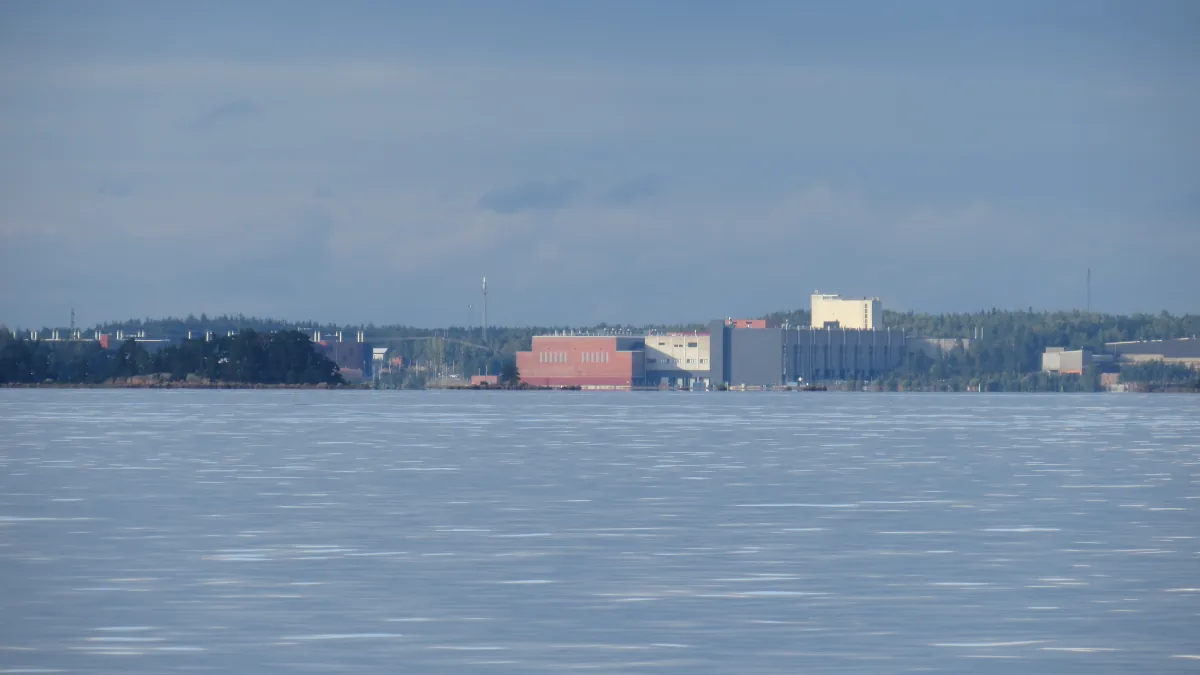
A large investment plan, with a future timetable
Google announced on September 9 that it plans to invest €13 billion in Finland in 2027 and 2028. Its expansion includes data-centre infrastructure and a broader energy partnership. The distinction between a commitment and completed spending matters: this is a plan for the next phase of construction, not a report that every facility is already operating.
Google already has a data centre in Hamina, in a former paper mill. The company points to seawater cooling and the reuse of heat outside the site as features of that existing operation. Those examples explain why a data centre belongs in an industrial and energy story as much as in a story about software.
Sources: Google: Our long-term AI commitment to Finland; Fortum: Nuclear power purchase agreement with Google
The cloud still runs on machines
An AI service reaches the user through an app, but the work takes place on computing hardware. Data centres need electricity for that hardware and the supporting equipment that keeps it running. The International Energy Agency's April 2026 assessment puts global data-centre electricity consumption at 485 terawatt-hours in 2025 and projects roughly 950 TWh in 2030.
That second number is a projection, not a meter reading from the future. The IEA also identifies constraints involving grids, transformers, chips and approvals. In practical terms, a company cannot deliver computing capacity simply by announcing a model or ordering processors. Suitable sites and dependable electricity become part of the schedule, and a bottleneck in one can delay the rest.
Sources: IEA: Key Questions on Energy and AI — executive summary, 2026
Google is buying electricity, not half a nuclear plant
Fortum says the companies signed a 22-year power purchase agreement, often shortened to PPA, covering up to half of the capacity of its Loviisa nuclear power plant. The wording refers to that plant, not half of Finland's electricity. Fortum remains the owner of Loviisa.
A PPA is a long-term arrangement for purchasing electricity. For the producer, a committed buyer can make future revenue more predictable; for the customer, the agreement helps secure supply over a longer horizon. It does not, by itself, transfer ownership of the generating station or reveal what ordinary households will pay for electricity. Those are separate questions from the contracted volume.
Sources: Fortum: Nuclear power purchase agreement with Google
This agreement supports an existing plant
The Loviisa deal supports extending the plant's operating life to 2050. Fortum's announcement connects the agreement to its investment programme for the existing facility. It should not be described as Google opening a new nuclear reactor, or as a new station already approved and built.
Roschier, the law firm that advised Fortum, gives a more specific timetable: purchases will begin gradually in 2028, with up to 50% of the plant's capacity covered during 2030–2049. The companies also signed a memorandum of understanding to explore further cooperation, including new nuclear power. An agreement to explore options is not a final investment decision on a particular new project.
Sources: Fortum: Nuclear power purchase agreement with Google; Roschier: Fortum and Google sign a 22-year PPA
The battery figure does not tell us how long it will last
The partnership also includes a 94-megawatt battery system associated with Google's Kajaani data centre, according to Fortum's adviser. A battery can help manage changes in supply and demand, but its power rating is only half the description needed to understand what it can do.
The US Energy Information Administration distinguishes power, measured in megawatts, from stored energy, measured in megawatt-hours. In a simplified example, a 100 MW battery with 200 MWh of usable energy could discharge at full power for about two hours, ignoring losses and operating limits. A 100 MW battery with 400 MWh could do so for about four. These are illustrative numbers, not specifications for Google's system.
The reviewed announcements do not give us the Kajaani battery's energy capacity in MWh. Consequently, 94 MW alone cannot establish how many hours of backup it provides, or whether it could run an entire data centre through an extended interruption. Storage also has to be charged: it is not a primary source of energy.
Sources: Roschier: Fortum and Google sign a 22-year PPA; EIA: Battery duration, power and stored energy
Construction activity and permanent jobs are different
Google estimates its programme will support 37,000 jobs during the construction phase in 2027–2028. That is the company's economic-impact estimate, not an announcement that it has hired 37,000 permanent data-centre employees. The period, the definition of a supported job and the method behind an estimate are essential to interpreting a large employment number.
Lumacta's assessment is that benefits could reach several groups: construction firms, equipment suppliers, local service businesses and workers with relevant technical skills. But the distribution will matter as much as the total. A region can host substantial investment without every resident gaining a new job, and a temporary construction peak is different from sustained activity after buildings are complete.
More electricity demand does not settle the price question
The IEA's 2026 analysis warns that data centres create large, concentrated loads and may require new generation and grid investment. It also says higher demand does not inevitably mean higher prices if infrastructure and policy are handled well. That makes blanket predictions about cheap power or unavoidable household price rises premature.
For communities, our interpretation is that the important accounting includes both sides: local economic activity and services on one side, infrastructure requirements and who pays for them on the other. The public announcements reviewed here do not provide a complete, site-by-site calculation of those outcomes. A low-carbon supply contract is one part of the picture, not a full local impact assessment.
Sources: IEA: Data-centre electricity use and infrastructure pressures
The AI race is becoming an infrastructure race
The wider lesson is that computing investment increasingly depends on long-lived physical assets. A software feature can change rapidly; a power contract signed for decades connects that fast-moving industry to a much slower planning horizon. Finland's announcement makes that connection unusually visible.
Our conclusion is neither that this spending guarantees prosperity nor that it must harm other electricity users. It creates an opportunity whose value will depend on delivery: facilities completed, energy supplied, costs allocated and durable local benefits. The next meaningful milestones are construction progress and the implementation of the agreements, not another repetition of the headline investment figure.
Sources: Fortum: Nuclear power purchase agreement with Google; IEA: Key Questions on Energy and AI — executive summary, 2026
Sources & Methods
Checked September 10, 2026 against Google's September 9 announcement, Fortum's stock-exchange release, its legal adviser's transaction account, the IEA's April 2026 assessment and EIA battery definitions. Company impact estimates are attributed, not independently audited. Battery-duration examples are hypothetical arithmetic. Community implications and the conclusion are Lumacta analysis.
- Google: Our long-term AI commitment to Finland — Primary source
- Fortum: Nuclear power purchase agreement with Google — Stock-exchange release
- Roschier: Fortum and Google sign a 22-year PPA — Transaction adviser's account
- IEA: Key Questions on Energy and AI — executive summary, 2026 — Independent energy analysis
- IEA: Data-centre electricity use and infrastructure pressures — Independent energy analysis
- EIA: Battery duration, power and stored energy — Technical background