
An early black hole gets a tighter deadline
ESA announced on November 24 that Euclid had found the most distant confirmed quasar. The source, J1504+6252, appears as it was about 630 million years after the Big Bang. Its central black hole has an estimated mass of 360 million Suns.
The scientific interest lies in putting a large object on an early deadline. A growth model now has to explain how something so massive could exist by that point. The discovery gives astronomers another demanding case against which to test their explanations, while leaving the route to that mass open.
For readers following the succession of early-universe discoveries, the useful question is what each new observation constrains. Here, the combination of an early epoch, a substantial mass and evidence about its activity provides more information than a distance record alone.
Source notes: 1.
The evidence grew beyond a red dot
The author-hosted manuscript describes follow-up with Keck, Hubble, the Large Binocular Telescope and Webb. Webb spectroscopy measured a redshift of 8.129, with a quoted uncertainty of 0.005. Broad emission lines and the continuum support its identification as a classical quasar.
That sequence makes the discovery more useful than an appealing candidate selected by colour. An image can identify something worth investigating. A spectrum adds a pattern that researchers can compare with physical interpretations. Combining those kinds of evidence helps establish what the source is and where it belongs in cosmic history.
This record concerns a confirmed classical quasar. Earlier candidate accreting black holes have also been reported, with different observational classifications.
Source notes: 2.
Redshift connects the observation to an earlier universe
As NASA explains, expanding space stretches travelling light to longer wavelengths. Astronomers examine the displacement of familiar spectral features to measure cosmological redshift. Infrared-sensitive instruments can receive ancient light that has shifted beyond the visible range. The observation therefore carries information about the past as well as the source.
The distinction between a measurement and its interpretation matters here. Researchers measure the spectrum, then use a cosmological model to translate the redshift into an epoch. Reporting the age of the universe at that epoch gives readers a useful clock. It also avoids treating the time the light travelled as a simple description of present-day separation.
For this story, keep the clock attached to the light being observed. The announcement describes a source in the early universe. It provides a historical view of that source rather than a live account of its condition today.
Source notes: 3.
The mass estimate has a meaningful range
Sky & Telescope explains that the gas orbiting the black hole helps establish its mass, with estimates spanning roughly 200 million to 800 million solar masses. Its reporting also stresses that different formation pathways could contribute to the quasar population. The prominent single-number estimate should be read alongside that uncertainty.
A range that broad still leaves an important conclusion intact. Every value in it describes an enormous object for the available time. The range does, however, affect how demanding a particular growth history becomes. A model that works near its lower end may face a harder task near the upper end.
That is a more useful way to read an uncertainty than treating it as a reason to discard the result. Ask which conclusions survive across the plausible range, and which depend on choosing one estimate. The existence of a substantial early black hole is the robust challenge. The exact history remains a more conditional inference.
Source notes: 4.
Its present activity leaves a history to reconstruct
The Max Planck account says the source is feeding well below the Eddington limit, the benchmark associated with radiation opposing incoming gas. Extending that subdued behaviour over its entire past would require a difficult initial seed. The researchers consider a larger starting seed and stronger earlier feeding, including a direct-collapse origin, as possible explanations.
The observation captures a state, while the formation question concerns a history. A currently moderate rate can coexist with a much more active earlier phase. Similarly, starting with a larger seed reduces how much subsequent growth an explanation must supply. Those possibilities can be compared without assuming that this observation uniquely selects one.
Lumacta’s assessment is that this is where the discovery has its lasting value. It forces explanations to account for the early deadline and the observed state together. Declaring one universal origin for all supermassive black holes would go beyond that evidence.
Source notes: 5.
Read the image alongside the measurements
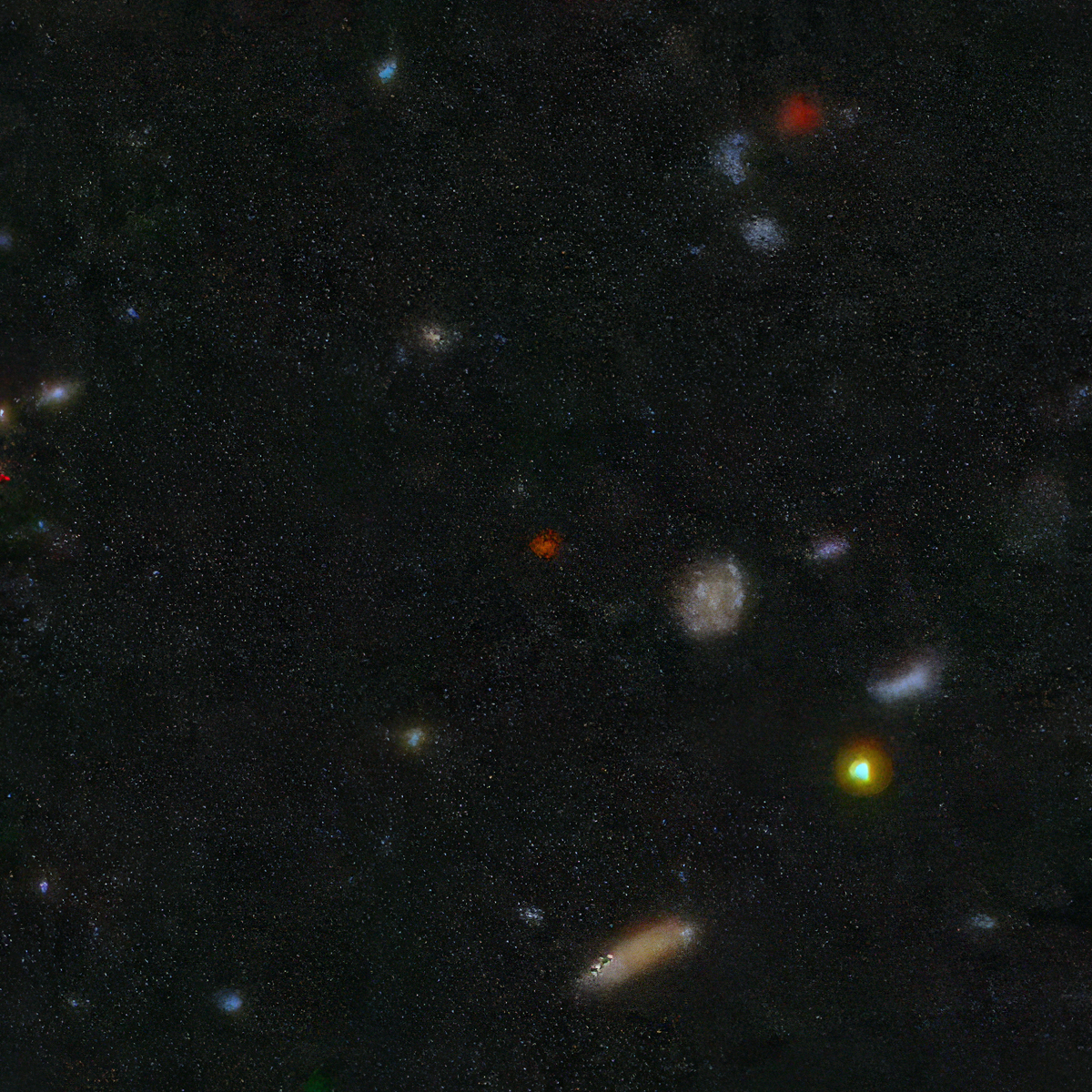
The accompanying Euclid image was released on November 24. It is an observational colour composite, combining optical and near-infrared data. The small reddish source sits among other objects in the field. The release page does not provide the individual exposure dates.
Its modest appearance is part of the story. The field image gives the discovery a visible setting, while the identification and physical interpretation depend on the measurements discussed above. Keep the spectrum, the mass estimate and the growth models beside the image when assessing a dramatic headline.
The most informative next developments would strengthen those comparisons. Better constraints on the mass would narrow the histories that remain viable. More quasars at similar epochs would show whether this case is unusual or part of a wider pattern. A still earlier discovery would move the deadline again.
For now, the record supplies a specific new test. Any successful explanation must produce a massive black hole early enough, while remaining compatible with what astronomers can actually observe. That is a concrete advance even while the origin remains unresolved.
Sources & Methods
We read ESA’s announcement and the research institution’s linked manuscript, compared the interpretation with independent reporting, and checked the released observational image. The author-hosted PDF has an earlier manuscript date and an acceptance placeholder; ESA and Max Planck identify the journal publication as November 24. The final journal PDF was inaccessible. The explanations and assessment are Lumacta editorial analysis.
- ESA discovery announcement — Primary announcement, November 24, 2026.
- Wolf and colleagues manuscript — Author-hosted manuscript provided by the research institution; dated September 11. The final journal version was not accessible.
- NASA explains cosmological redshift — Primary educational context; updated September 17, 2024.
- Sky & Telescope reporting — Independent November 24 reporting by Monica Young, including an interview with a study participant.
- Max Planck research account — Primary institutional explanation of the growth scenarios, November 24.
- ESA observation image — Exact observational image, release date and credit; individual exposure dates are not supplied.
- Image reuse licence — Attribution-ShareAlike 3.0 IGO; applies to the image, with credit and retained licence notice.