

A stronger model makes the workflow more important
The practical question is which part of a task earns a model change. A difficult migration, a stubborn discrepancy in a dataset or a design with several interacting constraints can justify more expensive reasoning. A routine rewrite with a clear answer may not. Our recommendation is to choose the smallest workflow that can demonstrate a useful result, then escalate the part that remains difficult.
This guide follows that decision from the demonstrations to a practical setup: what the evidence establishes, how access and settings differ, and what to ask the model to deliver. A clear acceptance test is more valuable than an elaborate prompt that leaves success undefined.
The gadget designs show a useful chain of work
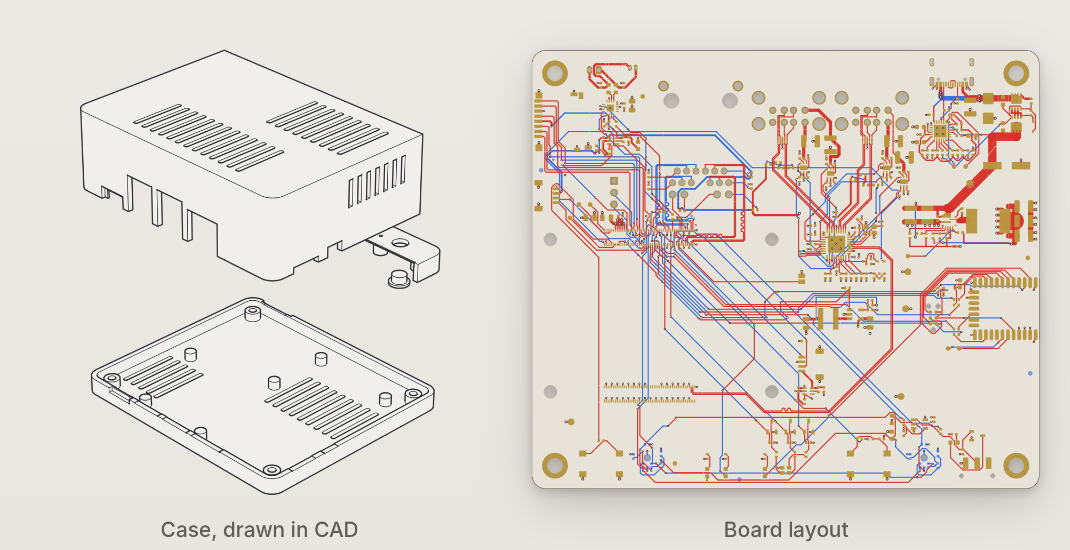
In Anthropic’s electronics experiment, Fable produced designs for a voice-assistant hub, a USB speakerphone and a virtual pet. The work connected component selection, board routing, enclosure geometry and firmware. Diode manufactured and assembled the prototypes with human engineers, and Anthropic reports that all three functioned without circuit changes.
The excerpt below matters because the enclosure and board must agree with each other; a convincing drawing alone cannot establish that fit. The research report leaves electrical validation, antenna tuning, thermal testing and certification outside this experiment. These are prototypes, not production-qualified consumer devices. Anthropic also discloses a commercial relationship with Diode.
Source notes: 2.
The thousand-agent result is also a lesson in infrastructure
The accompanying engineering report describes a roughly 1,000-agent effort that completed a Lean-checked formalization of Fermat’s Last Theorem in 28.7 hours. The setup supplied theorem statements, definitions, a proof-route sketch, previously proved lemmas and the Lean/Mathlib environment. Each model ran once; an extension followed.
This is a verification achievement for existing mathematics. It is also a reminder that the agent, task decomposition, shared state and checker form a system. Copying a headline about the number of agents does not reproduce that system. For a smaller project, one clear verifier and a few well-chosen checkpoints may deliver more value than a large team with overlapping responsibilities.
A perfect score can still come with a larger bill
Plotly’s own data-analysis exam provides a useful counterweight to the launch story. Fable answered all 43 questions correctly; GPT-6.1 Sol reached the same score. Plotly reports full-run costs of $35.74 and $2.61 respectively, using its analytics harness through OpenRouter. The exam uses a private synthetic wind-energy warehouse, and the published comparison is one run per model. Plotly sells analytics products, so its task design is relevant to that domain rather than a neutral sample of every possible job.
Artificial Analysis separately lists Fable configurations at different effort levels. Its Max and Medium “Default Fallback” entries show different composite scores, token costs and estimated task times. These are configuration-specific results, not an isolated experiment changing only effort. The task-time estimates are calculated from token use and endpoint speed across its benchmark mix. They are not a stopwatch prediction for your repository, and they reinforce why a model name without its settings is an incomplete comparison.
The practical conclusion is to measure the completed task. Include tool calls, retries, cache writes, verification and the time spent repairing a wrong answer. A lower token price or a stronger headline score can coexist with a more expensive successful run.
What early reviewers actually demonstrated
In a launch-day How I AI review, Claire Vo described strong animation and coding results after two days of use. She showed branded animation and a game, and discussed architecture work on ChatPRD’s data pipeline. That migration was still in progress. Her counterpoint was visual taste: without brand constraints, she disliked its website designs. This is a personal account with concrete examples, rather than a controlled model comparison.
Matt Wolfe reported no early access and only a few hours of use. His game example worked mechanically but disappointed him visually. He also inspected generated gadget files and instructions; he had not built the device. Some later showcase clips belonged to other creators and should be understood as their examples.
Both original videos are linked in the sources. Their different experiences are useful prompts for your own trial: provide the actual brand system if appearance matters, and assess a finished artifact against the same criteria you would apply to work from a colleague.
Ambitious projects expose a gap between capability and judgment
Ethan Mollick’s November 9 account is striking for the scale of its projects and the supervision they still needed. He describes code-rendered 3D worlds, a literature course and a draft research paper. The course needed feedback on engagement; the paper grew to 182 pages; the world-building agents accumulated an elaborate approval process. His assessment is broad capability with uneven judgment, rather than dependable autonomy. He had prerelease access with unmetered token use, so these projects cannot establish an ordinary customer’s bill.
Every’s Dan Shipper makes a related distinction between an ambitious handoff and an everyday conversation. His team’s examples include the EveryCut video editor, while his assessment of ordinary prose is less enthusiastic. He recommends reserving the more intensive workflow for work substantial enough to justify it. Every received prerelease access and free tokens. Its own product demonstrations are selected examples, and the video’s dollar illustrations use older model rates rather than measured launch-price bills.
These accounts suggest a different acceptance test for a long project: ask whether the result is usable by another person, not merely whether its components exist. A course must teach, a video must hold attention and a research document must make its argument possible to inspect. Set a target format and a stopping condition at the start. Schedule an editorial review before allowing the system to add another feature, agent or rule.
Real coding accounts show why effort and task shape matter
DataCamp editor Tom Farnschläder tested a stormy lighthouse shader in fresh OpenCode sessions with identical prompts, high effort and file-reading/editing tools only. His November 10 comparison judged Fable’s depth and lighting better, but reported a $4.91 run against Astra’s $1.75. Fable used 95,683 output tokens including reasoning, versus 22,934. Each model received one attempt. This is evidence about one visual build and an editor’s judgment, rather than a reliable overall model ranking.
Simon Willison’s informal drawing trial makes the effort trade-off tangible. He tried the same pelican SVG request at five effort levels and preferred xhigh. At max, the run exhausted 128,000 tokens without returning the image. The distinction is a missing deliverable in that attempt, not 128,000 tokens of useful visible output. A larger reasoning allowance is therefore a control to evaluate, rather than a substitute for an output check.
Willison’s Beep Locator is a more practical project account. Opus produced the initial system, and Fable continued its development. Automatic positioning was unreliable, so the work incorporated approximate device placement, microphone logs, clap checks and replay. He reports locating the noisy device within roughly 40 centimetres. The outcome belongs to that combined workflow: earlier model work, human setup and repeated checks all mattered.
The useful comparison is a ladder of increasingly realistic evidence. A single visual prompt can reveal an obvious strength or failure; a small repeatable task can expose variability; an integrated project reveals whether debugging, handoffs and review remain manageable. For your own codebase, keep a representative failing test and a bounded change as the first trial. An impressive unrelated demo is a reason to investigate, rather than a reason to migrate every task.
Business evaluations separate a high rating from dependable delivery
Spring Prompt’s Ellis Crosby reports synthetic business evaluations with public methods and result data. In nine survey tasks, the selected data classify four Fable results as fully sound, against six from GPT-6.1 Sol’s earlier run; mean inference costs were about $1.51 and $0.14. In a separate test of 56 invented products, each repeated three times, Fable’s factual listings passed every repeat for 71.4% of products, against Sol’s 75.0%; Fable’s rate fell to 44.6% with a sales brief. The Fable observations are dated November 10, while those Sol runs are from September and October. Provider-default configurations and model-assisted judging also limit the comparison.
The figures above use the versioned result data rather than an overall leaderboard rating: the review page and current dataset showed different ratings during our check. Spring Prompt sells model evaluations, and its tasks address business work rather than repository engineering. Source: Spring Prompt public results, release 2026-11-10-8342a7178929, CC BY 4.0; values selected and rounded by Lumacta.
For a commercial workflow, separate persuasion from factual permission. Give the model the claims it may make, the evidence for each and the fields it must leave unknown. Check a sample for unsupported promises before allowing the output into a catalogue or campaign. A fluent product description can be attractive while still failing the business requirement. The decision should turn on the proportion of usable outputs and the cost of reviewing them.
A small scientific demo makes the output easy to inspect
Stephen Turner’s November 10 account offers a compact example of an inspectable deliverable. He published a browser app that encodes a sentence as simulated DNA reads and compares assembly with and without paired information, including a failing example. He reports one prompt, no follow-up and about 15 minutes, using roughly 5% of his weekly allowance. Those are his account-specific observations during the launch period. The app is an educational simulation, not evidence that the model validated real biological research.
The useful design choice is that a reader can see the input, the two outcomes and a failure case together. Apply that pattern to your own request: ask for a small artifact with a visible check before expanding its scope. For a dashboard, show the records behind one total. For a visual project, provide a reference and inspect the actual output at its intended size. For a research task, make the evidence trail and unresolved questions easy to find.
Source notes: 30.
Choose the model around the bottleneck
Fable and Mythos share an underlying model, with different safeguards and access conditions. Mythos is offered to approved organizations doing eligible cybersecurity or life-sciences work. It is not a general upgrade that every subscriber can select.
For ordinary work, Anthropic’s Opus starting point is sensible. Our additional rule is to preserve the evidence from a failed attempt before escalating: the test output, the contradictory totals or the unresolved design constraint. Give Fable the specific problem that needs a stronger diagnosis. Repeating the entire job with a grander instruction often makes it harder to tell what improved.
Use a cheaper model for bounded, repetitive work when it meets the same checks. Reserve specialist access for the approved activity it supports. The routing table below is editorial guidance, not a claim that one model wins every task in that row.
| Task or constraint | Starting point | Evidence to keep |
|---|---|---|
| Everyday coding or knowledge work | Opus 5.5 | The acceptance test and reviewable output |
| A difficult technical task remains blocked | Consider Fable 5.2 | The reproducible failure or unresolved constraint |
| Repetitive, well-bounded work | A cheaper model that meets the checks | A representative sample of correct results |
| Eligible specialist cybersecurity or biology work | Approved Mythos access | Program eligibility and task-specific validation |
Route the task, then verify the result
Three starting routes for different kinds of work. This is editorial guidance, not a benchmark.
- Routine workOpus 5.5
- Hard technical taskFable 5.2
- Vetted specialist workMythos 5.2
Start with the right interface and an explicit model
In Claude’s apps, use the model picker and check whether the account and workspace expose Fable. In Claude Code, the current documentation requires version 2.1.321 or later for Fable 5.2 and documents selection through /model. Use the explicit model name when an alias could resolve differently through a gateway.
Keep the interface defaults separate. Claude Code starts at Medium, while the Fable API specification defaults to high effort. The API model identifier is claude-fable-5-2, with a one-million-token context window and up to 128,000 output tokens. That capacity can hold a large task; it does not make an undifferentiated dump of files a good brief.
Before the first substantial run, identify the source files, the permitted workspace, the desired outputs and a stopping point. Start with read-only investigation when the problem is unclear. Save the baseline so an attractive result can be compared with what actually changed.
Give it an assignment that can pass or fail
A useful brief has four parts: the problem, the evidence, the boundaries and the acceptance test. For example, a team reconciling two exports can ask for the first reproducible mismatch before authorizing a correction. That keeps the task small enough to inspect and makes a plausible explanation distinguishable from a demonstrated cause.
Example brief: Investigate why these two read-only CSV exports disagree. Identify their grain, date ranges and join keys. Show the first mismatched total with a reproducible query. Propose the smallest correction and the checks that would establish it. Preserve the raw inputs, do not connect to production, and stop for review before changing data.
Ask for the desired length and output structure directly. Anthropic’s prompting guidance notes that effort is not a reliable control for answer length and that broad instructions to take ownership can expand the work. For a coding change, request the relevant checks and a reviewable patch. For an illustration, supply dimensions, source material and the visual constraints that must remain intact.
Once the diagnosis is accepted, authorize the narrow change and compare the output with the original acceptance test. If it fails, pass the actual failure back into the next iteration. The animation below illustrates that loop; it is a workflow recommendation, not a timing or performance measurement.
Turn an uncertain request into a checked result
An original workflow illustration: plan the narrow change, build it, check the outcome and revise against the observed failure.
- Plan the smallest change
- Build a reviewable artifact
- Check the acceptance test
- Revise from real failures
Source notes: 5.
Effort, speed and spending are separate decisions
API effort levels run from low through medium, high and xhigh to max. Increasing effort can spend more reasoning tokens and time; it is not a requirement for every task. Begin with a setting appropriate to the difficulty, change one variable at a time and compare whether the extra work resolves a failure that matters. Keep a firm output and spending limit.
For an API integration, set output_config.effort explicitly. Where fast mode is supported, speed: "fast" requests the faster service. Use max_tokens as a hard output cap, and inspect the usage from a small representative call before scaling the workload.
Fast mode changes the serving speed, not the underlying model’s ability. Anthropic advertises up to 2.5 times the output-token generation speed, which does not promise a matching reduction in the whole task’s elapsed time. Claude Code’s /fast option uses usage credits even when subscription usage remains available. Enabling it late can reprice the context, so decide before an expensive conversation grows.
At standard API rates, Fable costs $8 per million input tokens and $40 per million output tokens; fast mode costs $16 and $80. A simplified run with 100,000 uncached input tokens and 10,000 billable output tokens, including thinking, would therefore be $1.20 standard or $2.40 fast. This arithmetic excludes tools, cache operations and other modifiers. It is an illustration of the tariff, not a forecast for completing a project.
| Model / mode | Input | Output |
|---|---|---|
| Fable 5.2 standard | $8 | $40 |
| Fable 5.2 fast | $16 | $80 |
| Opus 5.5 standard | $4 | $20 |
| Sonnet 5.5 standard | $2 | $10 |
A specialist consultation and a team solve different problems
Claude Code’s experimental Advisor feature, available on the Anthropic API, lets the main model consult a stronger model. It sends the conversation to the advisor, whose token use is billed separately; its input is not covered by the main model’s prompt cache. The documented controls do not provide a knob that guarantees a fixed number of consultations. This can suit a hard design decision, but it is not a free background safety net.
Managed Agents orchestration is a separate beta capability. Agents have separate contexts while sharing the sandbox, filesystem and credentials, and their tokens all count toward the budget. That is useful when work can be divided into genuinely independent pieces. It also means a team needs clear ownership of files and an integration check.
Our preference is a small, deliberate division of labour: one investigation, one proposed implementation and one check against the requirements. Parallelize work because its dependencies allow it, rather than because a launch demonstration used a large agent count. Keep publishing, production access and other consequential steps as explicit decisions.
Check the plan before treating the launch offer as permanent
Fable is not included on the Free plan. Anthropic’s access documentation distinguishes plans and seat types: eligible Max, Ultra and premium seats can use Fable within a share of their weekly limits, while Pro and standard Team seats ordinarily use usage credits. Workspace administrators can also limit model access.
The launch offer temporarily changes that picture for eligible Pro and standard Team users. Its published window ends on November 16 at 23:59 Pacific Time, with Fable included for up to half of the weekly allowance. Resets have eligibility conditions; they are not an unlimited or permanent quota increase. Check the account’s current offer and remaining usage before beginning a long run.
AWS separately confirms Fable availability on Bedrock and Claude Platform on AWS. Availability across clouds does not establish that every app, advisor, fast-mode or orchestration feature behaves identically on each platform. Follow the documentation for the endpoint you actually use.
Existing API integrations need a real migration check
An older request template may be incompatible with this release. The migration guide says to omit temperature, top_p and top_k; manual or disabled thinking and assistant prefill are also unsupported. For tool selection, auto and none are accepted, while forced any or a named tool produces an error. Update the request shape before assuming that a failed call reflects weak reasoning.
Preserved thinking adds another integration constraint: changing earlier system instructions, tools or conversation history can invalidate the preserved state. Use the documented conversation-management mechanisms rather than silently rewriting an old exchange. Test retries, compaction and error handling with representative inputs before moving a working application over.
Data handling belongs in the same decision. Anthropic documents a 30-day safety-monitoring retention requirement for Fable and Mythos API use, with zero-retention access requiring express authorization. Do not infer that an enterprise exception applies to an ordinary account merely because the model appears in the picker.
Our recommendation: escalate the diagnosis, keep the checks
For a difficult engineering task, Fable is worth considering when a stronger diagnosis could change the outcome: a migration with conflicting constraints, a stubborn defect with a reproducible test or an analysis that must reconcile inconsistent evidence. The strongest use case is not a longer answer. It is a better route to a result that survives inspection.
For routine work, begin with the model and interface that already meet your requirements. Keep a small set of representative tasks and judge correctness, completed cost and review time together. When moving to Fable, preserve the task, inputs and acceptance test so the comparison is about the model or workflow change rather than a different question.
The next useful evidence will be repeated results on longer projects, transparent accounts of failures and fixes, and costs for verified deliverables. Early demonstrations justify a serious trial. Your own decision should turn on whether the model removes a real bottleneck while leaving the result easier to check.
Sources & Methods
Evidence-led analysis of official documentation, primary experiments, task-specific evaluations and original accounts from eight reviewers and practitioners. Prerelease access, commercial context, configuration, observation dates and self-reported outcomes are distinguished. AI assistance was used in research and drafting.
- Anthropic — Primary
- Anthropic: electronics design experiment — Primary research report
- Claude engineering: the multi-agent proof run — Primary engineering report
- Fable 5.2 model specification — Official model documentation
- Prompting guidance for Fable 5.2 — Official implementation guidance
- Claude Code model configuration — Official product documentation
- API effort configuration — Official API documentation
- Claude Code fast mode — Official product documentation
- Claude Platform pricing — Official pricing
- Claude Code Advisor — Official experimental-feature documentation
- Managed Agents orchestration — Official beta-feature documentation
- Fable access on Claude plans — Official access conditions
- Fable 5.2 launch offer — Official temporary-offer conditions
- Fable 5.2 API migration guide — Official API migration documentation
- Preserved thinking — Official integration documentation
- Claude API data retention — Official data policy
- AWS: Fable 5.2 availability — Cloud provider confirmation
- Plotly: Fable data-analysis results — First-party independent evaluation
- Artificial Analysis: Fable at Max effort — First-party independent evaluation
- Artificial Analysis: Fable at Medium effort — First-party independent evaluation
- Claire Vo: hands-on account on How I AI — Original reviewer video and exported captions
- Matt Wolfe: first-look account — Original reviewer video and exported captions
- Claude Platform fast mode — Official API documentation
- Mythos 5.2 model specification — Official restricted-access model documentation
- Photo: TechCrunch Disrupt 2023 — Original photograph publication and CC BY2.0 attribution
- Ethan Mollick: projects and judgment — Original prerelease account
- Dan Shipper and Every: team review — Original team video and transcript
- Simon Willison: five effort levels — Original informal coding trial
- Simon Willison: Beep Locator — Original mixed-model project account
- Stephen Turner: sequencing demonstration — Original developer account
- Tom Farnschläder: shader comparison — Original comparative build
- Ellis Crosby: business evaluations — First-party synthetic business tests
- Spring Prompt: public result data — Versioned benchmark data; CC BY4.0
- Spring Prompt data licence — Data reuse conditions