
What changed today: ASUS says the hardware is shipping
ASUS said on October 20 that ZenWiFi BN12 is shipping after its earlier Computex unveiling. Its announcement emphasizes reliable connections, coordination between mesh nodes and performance farther from a router. These are the manufacturer’s descriptions, not independently measured outcomes in a home.
The distinction matters because a new network generation can sound like an answer before the problem has been identified. A person whose call breaks up upstairs has a different complaint from someone waiting for a large local video project to reach shared storage. Another household may simply have an internet service that is too slow for its simultaneous activities. Treating all three as the same speed problem produces an unhelpful comparison.
Our reading of the announcement is therefore about the path taken by the work. Which room matters, what is connected there, and where does the task go next? That framing makes the news useful without declaring a new router necessary or promising a result we have not observed.
Source notes: 1. Original editorial examples and interpretations are identified separately.
WiFi 8 branding does not mean the standards process has finished
IEEE’s current 802.11bn task-group page still lists final working-group approval for March 2028 and RevCom/SASB approval for May 2028 as projected milestones. Its stated goals include improvements in throughput under specified signal conditions, high-percentile latency and packet loss. They are development objectives, not measured BN12 results.
This places today’s announcement in a precise category: a manufacturer is shipping equipment under a next-generation label while the underlying amendment remains in development. A product shipment does not complete that process. Nor does a standards timetable establish which optional functions a particular firmware release implements or which combinations of devices have been tested together.
IEEE also specifies backward compatibility and coexistence as an objective. That should not be read as an upgrade to the radios inside existing phones. We have not established a Wi-Fi Alliance certification record for BN12 from the sources reviewed. Do not silently substitute shipping, standard approval and certification for one another; they answer different questions.
Source notes: 3. Original editorial examples and interpretations are identified separately.
The 19Gbps headline is an aggregate—not a download prediction
The BN12 specification lists maximum rates of 1,376Mbps on 2.4GHz, 5,764Mbps on 5GHz and 11,529Mbps on 6GHz. Adding those advertised figures gives 18,669Mbps, or about 18.7Gbps. That explains the rounded 19Gbps class; it is not a measurement of one file moving to one computer.
The same table lists a 10Gbps WAN/LAN port and another 10Gbps LAN port. These describe interfaces, not a promise that every transfer will reach their nominal rates. Its disclaimer explicitly warns that traffic, building construction and network overhead affect actual throughput and coverage. Some channel-width availability also varies by region.
The practical interpretation is to keep the numbers attached to their subjects. Three radio bands are not one demonstrated application connection. An Ethernet interface is not a storage benchmark. A faster internal route does not, by arithmetic alone, change an internet subscription. For a creator moving footage, the meaningful result is the completed transfer over the actual route—not the sum printed above it.
Source notes: 2. Original editorial examples and interpretations are identified separately.
Backhaul is the connection the second room still depends on
ASUS’s official AiMesh instructions distinguish the main router from additional nodes. They describe wireless and wired connections between them, including Ethernet backhaul as an option when distance or partitions make the wireless connection poor. This is existing AiMesh guidance, not a new capability invented by the WiFi 8 label.
Think about what a second unit is supposed to accomplish. It provides a closer place for a device to connect, but the task still needs a usable onward path. Assessing only the nearby connection leaves that other part unexplained. A strong-looking local link and a disappointing completed task are not necessarily contradictory observations.
For a home with usable network cabling, our assessment would give the layout as much attention as the generation number. For a home without it, the placement and behavior of the wireless connection between units deserve their own evaluation. We have not compared either arrangement on BN12. The point is to make the system intelligible: adding a box is not the same thing as demonstrating that every stage of a task has improved.
Source notes: 4. Original editorial examples and interpretations are identified separately.
Monitoring can help explain a problem; prioritization still makes a choice
ASUS’s product page describes WiFi Insight for interference monitoring and Adaptive QoE for traffic prioritization. It also advertises a two-pack coverage figure of up to 7,000 square feet. Those are different kinds of information: a diagnostic feature, a resource-management function and a coverage claim—not three interchangeable measures of reliability.
For an assessment, we would separate observing a connection from changing its priorities. First establish which task is struggling and whether that pattern repeats. Then ask what the automatic policy changes for that task and what happens to other work. Success should be defined before a favorable dashboard becomes the verdict.
A useful evaluation might follow the actual call or transfer through the rooms where it matters, retaining the same task when comparing settings. Record interruptions and completion, not only the most flattering instantaneous reading. That is a proposed way to evaluate the promise, not a benchmark we ran. Monitoring is valuable when it supports an explanation a reader can follow; automation is valuable when its choices match the household’s priorities.
Source notes: 5. Original editorial examples and interpretations are identified separately.
Our assessment: the route matters more than being first
The compelling idea is not owning a new number. It is making a shared connection behave predictably for work that matters. For a reader whose present setup already does that, this announcement alone does not establish a reason to replace it. For someone with a persistent problem, it provides a new candidate to investigate—not a diagnosis.
A serious comparison would make the intended improvement explicit, preserve a record of the existing setup and judge the finished task in the relevant rooms. That may lead toward new equipment, a different layout, cabling or no purchase. These are possible outcomes of an evaluation, not competing products we have tested or a recommendation based on an unverified price.
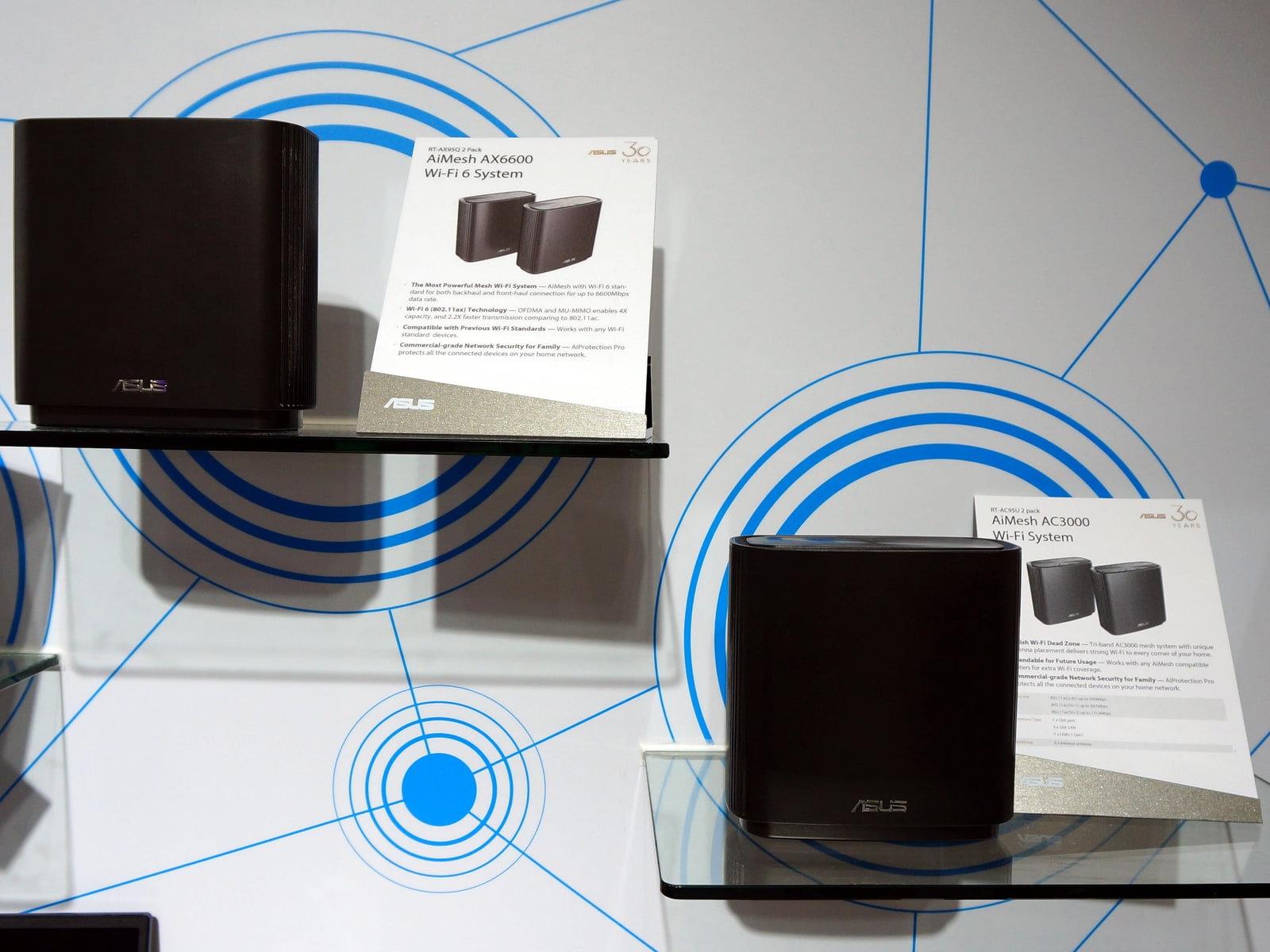
The accompanying real photograph shows ASUS mesh equipment at Computex in June 2019, not BN12. It is historical context, not evidence of this system’s performance. Today’s news is an announced shipment. What deserves attention next is credible evidence that the particular connection a household struggles with becomes more dependable—under conditions that are actually described.
Source notes: 1, 2, 3, 4, 5. Original editorial examples and interpretations are identified separately.
Sources & Methods
Prepared October 20 from five primary technical pages: the shipping release, complete model specifications, IEEE’s current background/timeline, relevant official AiMesh guidance and the complete product description. Manufacturer capabilities are attributed claims. IEEE milestones are projections, not promises. ASUS’s generic legacy footnotes and an inconsistent overview reference to a Gigabit WAN are not used in place of the model-specific port table. The aggregate-rate addition and route-based evaluation are original explanation. No router was installed, client compatibility certified, price verified or performance measured. The real photograph is dated archive context.
- ASUS: October 20 shipping announcement — Primary manufacturer release; complete body read
- ASUS: BN12 specification table — Primary model specifications; complete table and disclaimers read
- IEEE: 802.11bn project status — Primary standards working group; current background, objectives and milestone table read
- ASUS: AiMesh wired backhaul — Primary support guidance; complete relevant instructions and qualifications read
- ASUS: BN12 product description — Primary product page; complete feature description and disclaimers read