
A new opportunity after Monday's interruption
Arianespace is targeting November 24, from 10:45 to 11:14 UTC, for VA271/LE-04, carrying 36 Amazon Leo satellites. Its November 23 update says teams completed analyses and checks to prepare for launch operations to restart. The target remains a planned opportunity as this article is prepared on Tuesday morning.
The distinction matters for anyone following the buildout of satellite internet. A countdown, a launch and the delivery of working spacecraft are successive steps. The immediate news concerns a fresh opportunity to perform the launch. The evidence that matters next is whether the operation proceeds and whether the payload reaches its intended destination.
Source notes: 2.
The interruption happened on the ground
Arianespace's initial account identifies a technical event affecting ground-support systems. The countdown stopped before removal of the mobile gantry and before launcher-system operations began. The company described the launcher and satellites as stable and safe. It has not publicly identified the affected component in these updates.
That leaves a useful boundary around the explanation. The statement locates the issue in the supporting infrastructure without describing its precise mechanism. A reader should resist treating footage of the rocket as evidence that a visible part caused the interruption. Equally, the existence of a ground hold does not establish a problem that would have emerged during flight. Those are different questions requiring different evidence.
Source notes: 1.
Why the launchpad belongs in the story
ESA's account of Ariane 6's June 2024 rehearsal describes a coordinated exercise involving the flight vehicle, payload, launchpad, ground-control software and operational teams. That historical example explains why launch readiness extends beyond the rocket itself. It does not identify the cause of this week's event.
Think of the launch as a chain of accepted conditions. A vehicle can be ready for one part of a sequence while another necessary condition remains unresolved. The decision to stop keeps those distinctions visible. For a customer, a short delay still affects the timetable. Its significance depends on what engineers find, how they establish readiness and whether the same restriction returns.
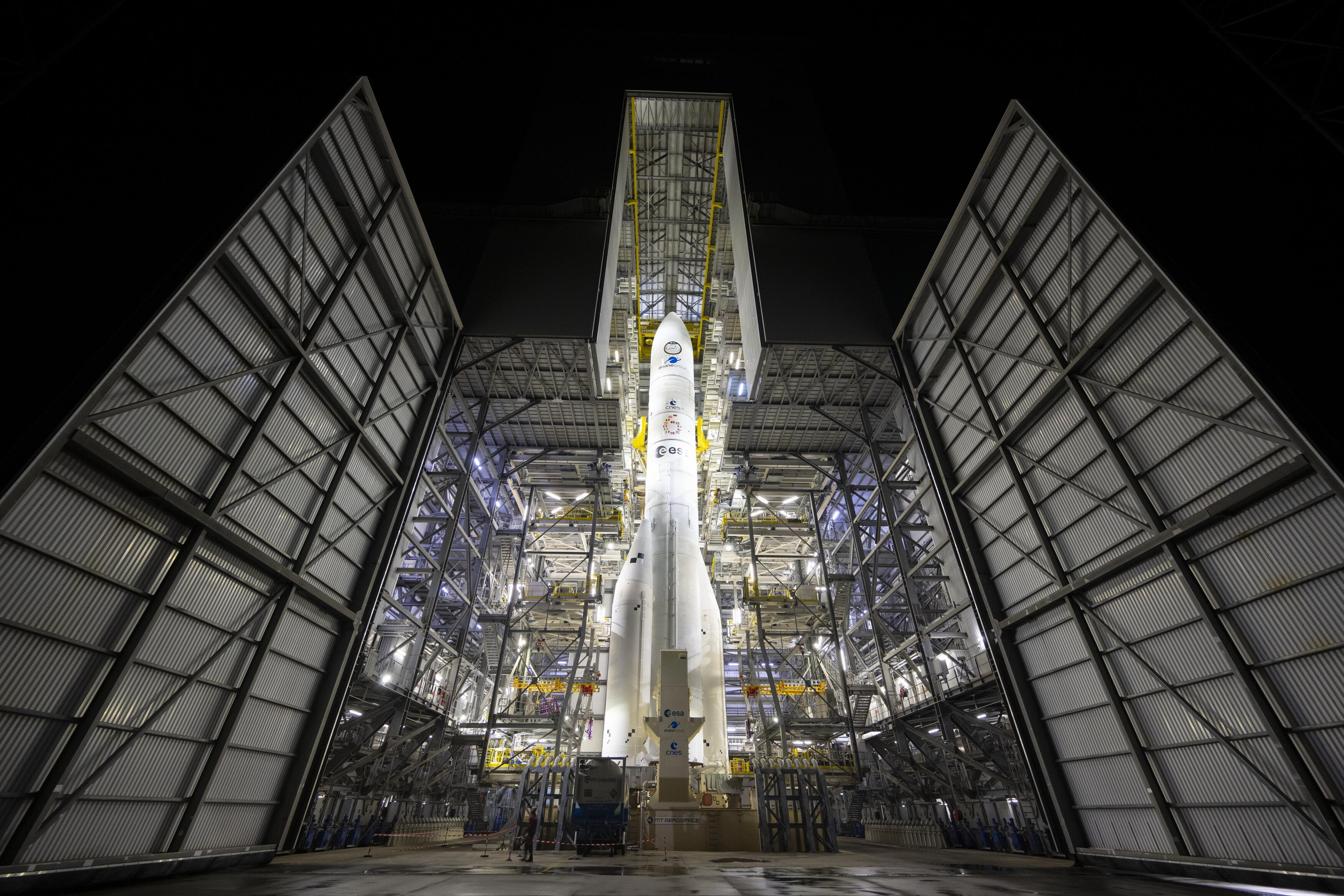
The archive photograph accompanying this report shows an earlier Ariane 6 inside its mobile building. It illustrates the physical setting. The mission now being prepared has its own hardware and operating record, so the image should not be read as a photograph of Monday's interruption.
The flight has a delivery task after liftoff
The operator's mission preview identifies this as Ariane 6's tenth flight and Arianespace's fourth launch for Amazon Leo. It specifies the four-booster Ariane 64 configuration. The subsequent schedule update places final satellite separation approximately two hours and four minutes after liftoff.
Those milestones give viewers a better way to follow the mission than a single launch clock. Liftoff would demonstrate that the ground sequence progressed to flight. The payload-deployment account would address a further part of the customer's task. If watching live, keep the mission's stated sequence beside the pictures and wait for the relevant confirmation before calling the delivery complete.
A scheduled interval is also different from a measured outcome. The separation timing describes what the mission intends to do. A post-flight account can establish what actually occurred and whether the entire payload was released. Any changes to that timeline should be attributed to the subsequent mission update.
What the hold tells us about the schedule
TeslaNorth's independent report also describes the gantry-stage hold and the revised window, drawing on Arianespace's statements. It provides a separate editorial account rather than an independent technical inspection of the affected equipment. The available reporting supports the changed timetable while leaving the detailed fault diagnosis with the operator.
For readers, the useful comparison is between the information available before and after an event. A published target supports planning. A hold notice explains why that plan stopped. A later readiness notice describes the basis for another attempt. A completed-flight report addresses the result. Keeping each claim attached to its stage prevents an old preview from turning into an accidental report of success.
This is particularly relevant when a launch has several public identifiers. Search results may preserve an earlier date alongside a newer announcement. Check the mission name, the payload and the date on the source before combining details. For this flight, VA271 is the Arianespace designation and LE-04 identifies the Amazon Leo mission.
What the delay means for the customer
Lumacta's assessment is that the immediate consequence is a shifted opportunity to add spacecraft, with the size of any wider disruption still dependent on the next attempt. It would take further evidence to quantify a financial effect, a change to service availability or a lasting effect on launch cadence.
Readers considering satellite internet should still check service availability at their address, installation requirements and the offered plan. A launch schedule cannot establish those household-level conditions, even if every spacecraft deploys as intended.
A simple example helps separate those questions. Suppose a customer plans work around the arrival of a shipment. Moving the delivery date changes the plan, but the customer still needs to know what arrived and whether it is usable. A satellite mission has additional verification steps, yet the distinction remains useful. Transport progress and service readiness answer different questions.
The same discipline applies to comparing launch providers. A ground interruption, an unsuccessful flight and a successfully delivered payload should retain their separate descriptions. A useful comparison would consider completed missions, the conditions of delays and a clearly defined period. This single hold cannot supply that wider assessment.
The next update should answer a narrower question
The next useful evidence is operational. Does Arianespace maintain the revised window, issue another hold or confirm liftoff? After that, look for the payload-release report. If the operator provides a component-level explanation, compare it with the earlier ground-system description rather than filling the gap with speculation.
For now, the strongest reading is straightforward. Arianespace has published a revised plan after checking the interrupted ground sequence. The mission still has to perform its flight and delivery. Following those separate milestones gives readers a clearer account of the event and a better basis for judging what it means for Amazon Leo.
Sources & Methods
We read the initial hold statement and subsequent French-language rescheduling notice, checked the mission preview against separate reporting, and used an older ESA rehearsal account only for context. The consumer implications are Lumacta analysis. The morning report precedes the new launch window.
- Arianespace reports the ground hold — Primary November 23 operational statement; ground-support event and stop before gantry removal.
- Arianespace announces the revised window — Primary November 23 French-language update; planned November 24 window and deployment interval.
- Arianespace mission preview — Primary November 18 mission preview; configuration and flight designation. Its original launch date is superseded.
- TeslaNorth reports the timetable change — Independent publication dated November 23 by Sarah Lee-Jones; reports operator statements, without independent equipment inspection.
- ESA documents the earlier rehearsal — Historical primary ESA account dated June 21, 2024, describing the June 20 rehearsal. General infrastructure context only.
- ESA archive photograph — Primary photo record identifying July 9, 2024, and ESA–S. Corvaja. Earlier mission, explicitly archival.
- ESA editorial-image terms — Current ESA terms, revised January 18, 2024, expressly permitting credited factual editorial use.