
An October announcement about an earlier experiment
Argonne’s October 1 announcement, republished by the Advanced Photon Source on October 2, describes a vanadium dioxide film that strains its sapphire support while switching electrically. The author abstract says that feedback from the support helps determine the conducting filament’s expansion direction.
The timing matters: PubMed records online publication on June 18, 2026, and a July 23 Science issue. October is the institutional reporting date, rather than the discovery or paper-publication date. We read the author abstract; the full Science article could not be accessed.
Our design interpretation is that choosing an active material and choosing what surrounds it are connected decisions. A useful specification would identify the assembly being tested. Otherwise, two devices carrying the same material label might be compared as though their surroundings could never matter.
Source notes: 1, 2. Editorial interpretation and illustrative calculations are identified separately.
Follow the loop before assigning the cause
A useful way to read the finding is as a loop: electrical activation changes the film, the film affects its support, and the support affects the film. That is our reading of the reported interaction, not a new measurement or a claim about every electronic substrate.
For an engineer, the proposed question changes from “What does this film do?” to “What does this assembly do under this input?” The distinction suggests a practical comparison: hold the intended electrical task fixed, vary the support deliberately, and track both electrical output and structural response.
Our proposed experiment would retain unsuccessful devices and repeated activation cycles. If only the best response is shown, a reader cannot distinguish a dependable feature from a favourable specimen. It should also separate a reversible change during operation from damage that accumulates after operation; those would imply different design choices.
Source notes: 1, 2. Editorial interpretation and illustrative calculations are identified separately.
An X-ray image answers a structural question
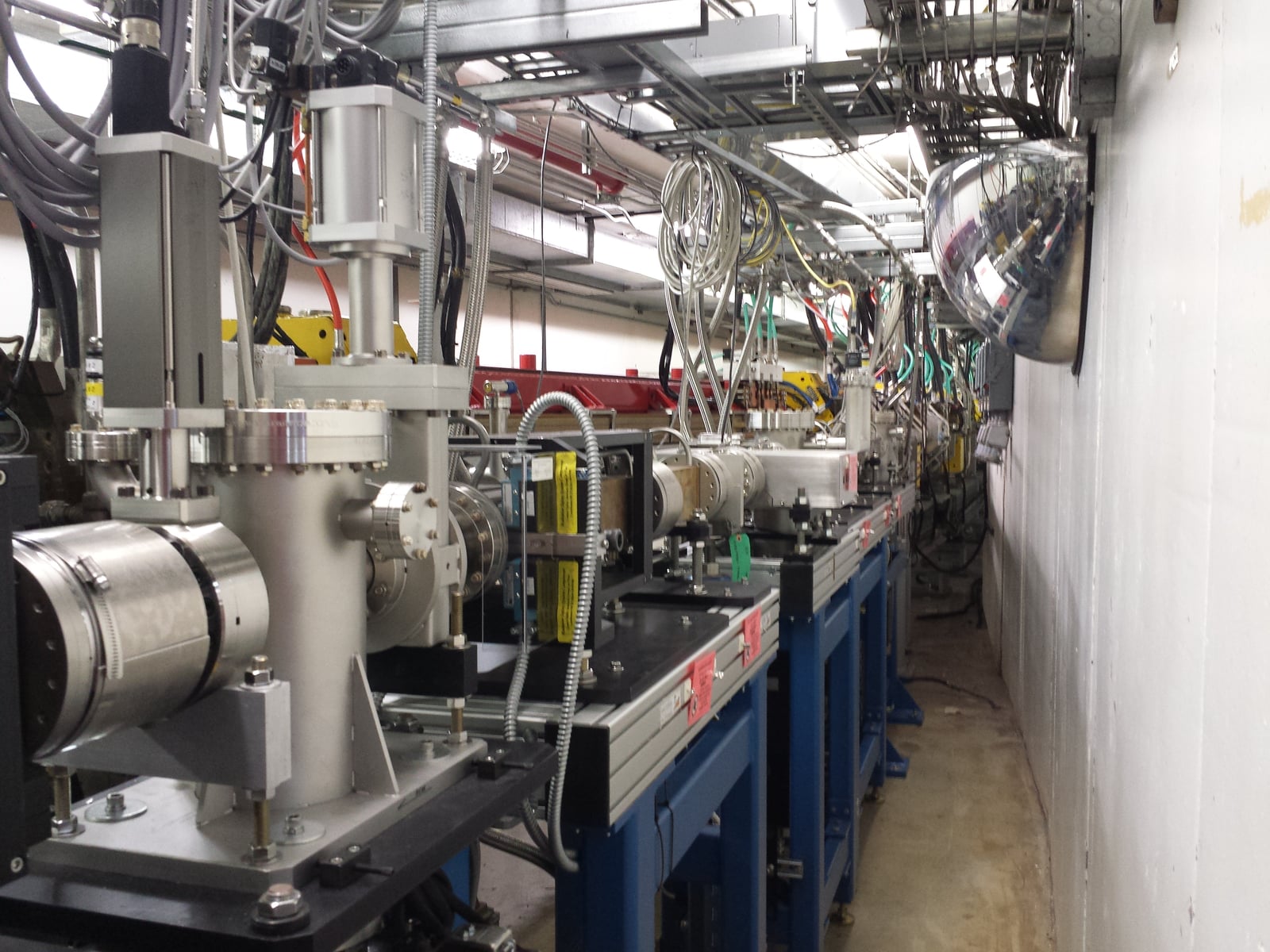
The announcement identifies dark-field X-ray microscopy at APS beamlines 6-ID-C and 33-ID-D. A separate January 2025 Communications Physics paper explains that this technique forms images from diffracted X-rays. Its contrast can reflect crystal orientation and strain, among other structural factors.
That background makes an important reading distinction possible. A structural image is evidence about material organisation under the measurement conditions. It does not directly measure a calculation’s accuracy, a finished chip’s energy use or a biological neuron’s function. Each proposed application needs its own observable result.
The older paper demonstrates depth reconstruction using patterned illumination in a different crystalline sample. It also describes beam stability and alignment considerations. Those details help us understand why an image needs an acquisition method and interpretation. They do not establish that the sapphire experiment used the older paper’s exact reconstruction procedure.
Source notes: 1, 3. Editorial interpretation and illustrative calculations are identified separately.
Depth, sideways reach and useful influence are different quantities
The new author abstract reports strain extending at least tens of micrometres into the support, more than 200 times the film thickness. This is a depth comparison. It supplies neither the sideways distance between interacting devices nor the magnitude of an effect on a neighbouring device.
Consider our invented dimensional example: a 0.1-micrometre film and a 20-micrometre affected depth give 20 ÷ 0.1 = 200. That ratio describes geometry alone. It cannot tell us whether a second device changes its output, how reliably it changes, or whether a designer would find that change useful.
The next proposed measurement would therefore map several things separately: where the structural response occurs, how large it is, how it varies through time and whether electrical behaviour changes at another location. A large depth ratio can be interesting while leaving all four practical questions open.
Source notes: 2. Editorial interpretation and illustrative calculations are identified separately.
A shared support could become a design variable
Our engineering question is whether neighbouring elements on one support can be made to behave independently when independence is required, or interact predictably when interaction is useful. Neither outcome follows automatically from observing one film–support feedback loop. An array needs an array experiment.
We would begin with two elements and a predefined input sequence. Activate the first, monitor the second, then reverse their roles. Include an unactivated comparison and repeat the sequence after changing their separation. Record failures and recovery time alongside any promising response. This is a proposed test, not reported work.
A useful result would distinguish intentional interaction from unwanted sensitivity. The same measurable connection might help one architecture and complicate another. The decision should depend on the intended task and acceptable variability, with those requirements written down before selecting the most attractive trace.
Source notes: 1, 2. Editorial interpretation and illustrative calculations are identified separately.
An interesting material interaction still needs a computing task
Our proposed assessment of a computing application starts with a fixed task, a defined output and a complete measurement boundary. Include the equipment needed to supply inputs, read outputs and restore the starting condition. A component-level observation cannot by itself settle that system-level comparison.
The practical significance of the report is a new question to put into the design review: should the supporting material be treated as an active variable? The checked evidence justifies investigating it. It does not establish a commercial chip, a working brain model or a proven energy saving for finished computation.
Source notes: 1, 2, 3. Editorial interpretation and illustrative calculations are identified separately.
Sources & Methods
Prepared October 5, 2026. We read the APS institutional report, the author abstract and chronology on PubMed, and the introduction, experimental results, discussion and methods of the separate 2025 microscopy paper. Science full text returned an access error; no full-paper or raw-data review is claimed. Announcement, republication and paper dates are distinguished. Our dimensional example, proposed comparisons and array evaluation are original analysis, not experimental results. No laboratory work, independent benchmark, expert interview or site visit was performed.
- APS: sapphire discovery could reshape future brain-inspired electronics — Primary institutional report: byline dated October 1, 2026; APS publication date October 2. These are the same report, not independent corroboration
- Kisiel and colleagues: dynamic asymmetric strain imprinted into substrates by an oxide thin film — Author abstract and primary publication metadata. DOI 10.1126/science.adt9347; online June 18, 2026, issue July 23. Full paper inaccessible
- Gürsoy and colleagues: dark-field X-ray microscopy with structured illumination for three-dimensional imaging — Primary open-access research paper, January 22, 2025. Read for microscopy background; its different crystal and illumination method are not assigned to the new experiment