
A new point of light in NGC 1433
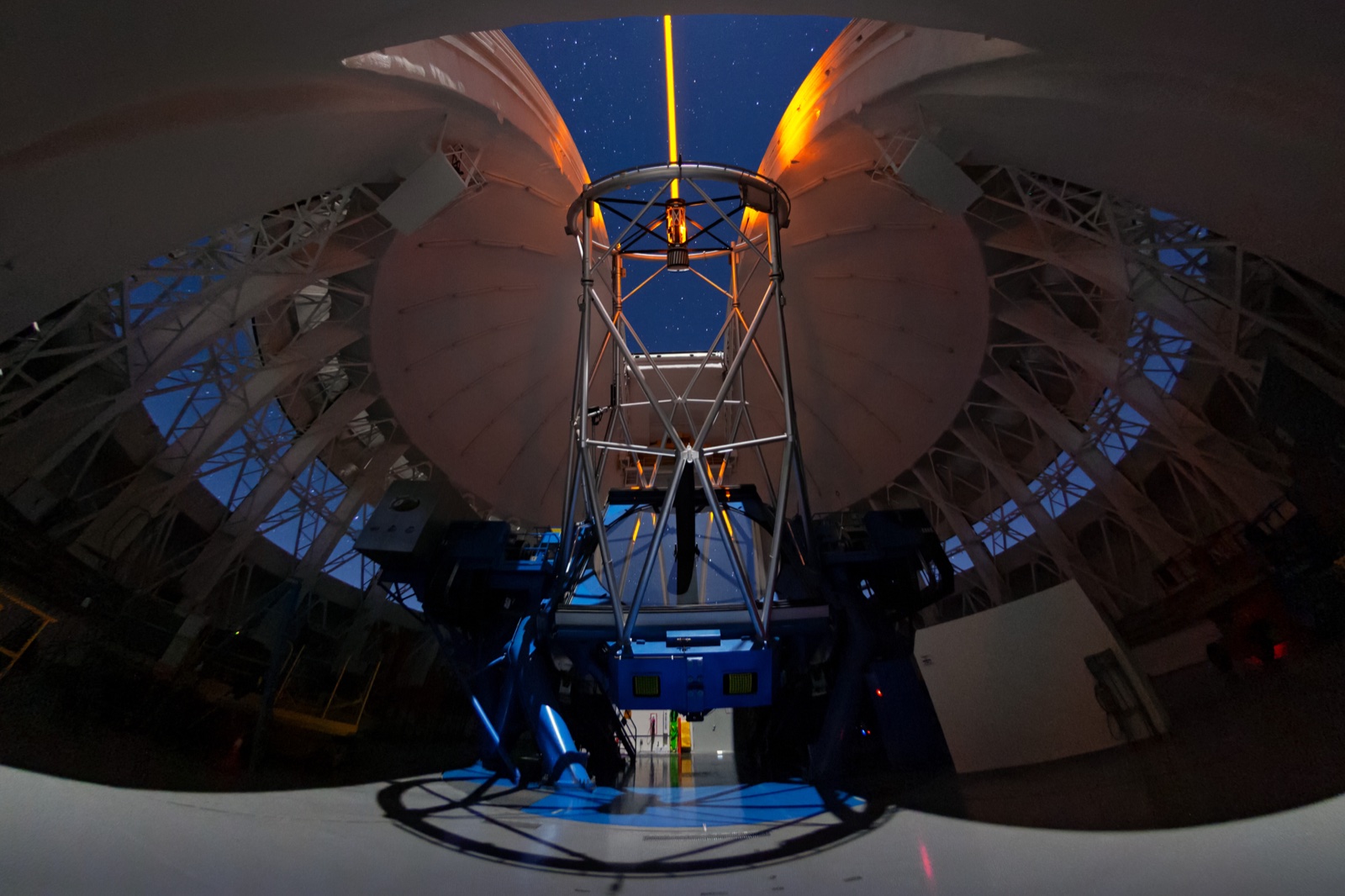
A spiral galaxy that had already been photographed for a dark-energy survey now contains a new point of light. On November 12, NSF NOIRLab released images of supernova SN 2026ahvu from Gemini South and the Dark Energy Camera in Chile. The first alert came from ATLAS on November 2. A spectrum from Keck II the next day identified a young Type Ia supernova. The new images show where it appeared while telescopes still have time to follow its rise.
NOIRLab forecasts maximum brightness between November 18 and 23, with an apparent magnitude of roughly 10.5 to 12.1. Different filters can peak on different nights, so the window is a forecast for planning observations. The new scientific opportunity is a series of measurements across that window, including the points on either side that show how quickly the light changes.
What a brightness measurement can tell you
An individual image tells an observer where to look. A light curve requires a time and a calibrated brightness for each observation. Filters matter because they select different parts of the spectrum. Two measurements made through different filters can disagree even when both are accurate. The galaxy’s own light also contributes to the image, so a useful measurement has to account for the background beneath the supernova.
Independent observer Pepe Manteca reported Johnson V magnitudes of 12.46 and 12.31 on November 11 and 12 UTC. Smaller magnitudes mean brighter objects. The latest point in his nine-epoch series was the brightest he had measured. A comparable follow-up is one more Johnson V observation under documented conditions. That is more informative than comparing the last value with a different instrument’s unfiltered number and declaring that the supernova has peaked.
The source lies in the southern sky. Practical visibility depends on latitude, local horizon and sky conditions as well as the telescope. An observer with a clean view and a calibrated camera can record the filter, time and uncertainty. Those details help other observers see whether two apparent changes are compatible.
Why the campaign needs more than one telescope
Pre-explosion DECam images provide a view of the galaxy before the new light appeared. Gemini’s newer observations help isolate the source. NOIRLab is coordinating additional work with those facilities and the Southern Astrophysical Research Telescope. If weather or daylight interrupts one telescope’s run, another observing site can fill a gap in the record.
Spectroscopy adds information beyond the changing brightness. It separates light into wavelengths, where broad absorption features carry clues about the material thrown out and its motion. The spectrum can also change as the expanding debris becomes easier to see through. This is why the Keck classification and a later series of spectra have different jobs. One identifies the type of event. The other can track its evolution.
Radio supplies a separate test. A team using MeerKAT reported that it found no compact emission in its November 7 observation at 1.5 GHz, placing a three-sigma upper limit of 0.22 millijanskys. That is a constraint at a specified frequency, time and sensitivity. It leaves room for emission below the limit or at a later stage.
A clue to the star system before the explosion
Type Ia supernovae result from thermonuclear explosions of white dwarfs. Several routes can produce such an explosion, including interactions with a companion or a merger involving white dwarfs. The classification identifies the kind of explosion. Determining the history of the system requires evidence about what was there before it exploded.
A November 6 preprint by Sumit Sarbadhicary and colleagues compared the transient’s position with earlier Hubble and Webb images. Two ultraviolet-bright star clusters lie close to the supernova in projection. The team’s combined Hubble–Webb fit put their ages at approximately 37 million and 95 million years. If the exploded system belonged to either cluster, the system could have produced its supernova unusually soon after its stars formed.
Membership is the step that matters. Two objects can appear close on a sky image while sitting at different depths. Even on the image, the difference between the two projected offsets is comparable to the estimated positional uncertainty of the discovery. A better position and a better understanding of the local stellar population would strengthen the inference. The current result is a clue to a possible young progenitor, with both the association and exact age still open.
What to watch as the light turns over
Type Ia explosions help measure cosmic distances because astronomers can standardize their luminosities using the evolution of their light and other properties. A single brightness reading cannot do that work. The peak, color and rate of fading all matter, as does the effect of dust. Even the published distance estimates for NGC 1433 differ, which changes how an angular offset in the image translates into a physical separation.
The next milestone is a measured turn in the light curve, with repeated data in known filters. Later spectra and radio measurements can give the early results more context. The new photographs fix the scene. The sequence of observations is what can turn one nearby explosion into evidence about how these systems form and how accurately astronomers can use their light.
Sources & Methods
We compared the observatory’s image release with the discovery and classification record cited in the research preprint, a published radio observing report, and independent optical measurements and coverage.
- NSF NOIRLab’s November 12 photo release — Primary observatory statement distributed via Newswise
- Sarbadhicary and colleagues on the two nearby star clusters — Primary research preprint
- Cendes and colleagues’ MeerKAT observation — Primary observing report
- Manteca’s November 12 Johnson V observations — Independent observer’s reported measurements
- Independent coverage from IFLScience — Independent reporting
- A review of Type Ia progenitor scenarios — Scientific review by Ruiter and Seitenzahl
- A Guiding Star for Gemini South — Archive photograph and licence record
