
A concrete offer, but still an announced delivery date
Sigma announced its 50–120mm F2.8 DC OS Contemporary on October 8. Its U.S. release gives an October 22 dealer-availability date and $799 price. The current American product page also displays a starting price of $799. Neither is a Romanian quote or checkout we completed.
That makes this recent announcement useful to revisit today: it describes an option for a small shooting kit, not simply a distant development project. However, a listed launch date cannot establish when your chosen mount will reach a local shop or how the finished lens performs.
Our proposed first check is mundane: obtain the exact mount, tax-inclusive local price, availability and return terms. A lens that arrives after the assignment cannot solve that assignment, even if its specifications look suitable. Keep an existing workable setup until the replacement has demonstrated the required job.
Source notes: 1, 3. Editorial interpretation and illustrative calculations are identified separately.
Compact is a configuration-specific claim, not one universal number
The global specification table lists Sony E and Fujifilm X versions at 390 g, while Canon RF is 410 g. Their lengths are 99.0 mm, 99.3 mm and 97.0 mm respectively. The lens is designed for APS-C imaging, not full-frame coverage.
Our reading is that the portability proposition should be judged as a complete kit. Include the camera, batteries, hood and other equipment you actually carry. Comparing one lens’s bare mass with another setup’s packed weight would tell you more about the comparison than the purchase.
Mount compatibility and sensor coverage are also separate questions. A mount label is not evidence that every camera mode, firmware version or accessory behaves identically. Check the intended body and settings rather than assuming that a physically attachable lens supplies the full image area or all the control behavior you need.
Source notes: 2. Editorial interpretation and illustrative calculations are identified separately.
Crop changes the comparison of framing, not the printed aperture
For a nominal 1.5× crop, the arithmetic is 50 × 1.5 = 75 and 120 × 1.5 = 180: approximately a 75–180mm full-frame-equivalent angle of view. Using the 1.6× factor Canon explains for its APS-C cameras gives 80–192mm. These are framing comparisons, not changed physical focal lengths.
Do not convert that framing calculation into a new exposure setting. The lens remains a constant-F2.8 zoom. Comparing depth of field or image noise between formats requires more conditions than a focal-length multiplication; a similar composition does not establish identical images.
For an event photographer, our proposed framing check is to examine actual working distances. Can you include the people you need from the positions available? A narrow view can isolate a face beautifully but become awkward when you cannot step back. Lens selection should start with that constraint, not an impressive equivalent number.
Source notes: 2, 4. Editorial interpretation and illustrative calculations are identified separately.
Optical stabilization does not make a moving subject stand still
Sigma rates optical stabilization at 6.5 stops at the wide end and 4.5 at telephoto, under CIPA measurement conditions. These are manufacturer ratings, not results we reproduced. They should not be read as a promise of sharp moving subjects at much longer exposures.
Consider an invented exposure example. Two stops longer than 1/500 second is 1/125 second: four times the exposure duration. That arithmetic is not a suggested shutter speed or a prediction of this lens’s stabilization. It explains why compensating for camera movement does not remove the time during which a person can move.
Our proposed trial separates stationary detail from walking people and faster action, then compares usable images at the shutter speeds the assignment needs. Keep lighting, framing and camera settings documented. Otherwise, a successful stationary picture and a blurred moving subject may be answering two different questions disguised as one stabilization verdict.
Source notes: 2, 4. Editorial interpretation and illustrative calculations are identified separately.
Handling claims need a camera-and-project test
The U.S. announcement highlights an aperture ring; Sigma also says the optical design minimizes focus breathing. Neither statement establishes that exposure changes or a focus pull will look the way your production requires. We have not handled the controls or measured the framing change.
For video, our proposed check records a representative focus transition, an exposure adjustment and subject tracking with the intended camera settings. Compare the clip itself, including sound and unwanted changes, rather than only the feature list. Also verify that a still-photography success carries over to the recording mode you plan to use.
Our practical rule for environmental use is equally cautious: Sigma describes resistance to dust and splashes, not waterproofing. A forecast, location and working procedure still matter. Do not treat a resistance label as an invitation to expose equipment to conditions outside the manufacturer’s instructions.
Source notes: 1, 2. Editorial interpretation and illustrative calculations are identified separately.
Value means filling a repeated gap—not acquiring a new specification
Our editorial view is conditional: investigate if your current kit repeatedly misses the required framing or makes carrying the equipment impractical, and you can validate the replacement. If the existing lens already produces the needed pictures, this announcement alone does not establish a reason to replace it.
An invented cost allocation illustrates the question. Spreading $799 over 40 planned uses gives $19.975, approximately $20 per use, before tax, accessories, repairs or resale. It is not a forecast of income or affordability. If those uses never happen, the arithmetic cannot turn an unused lens into good value.
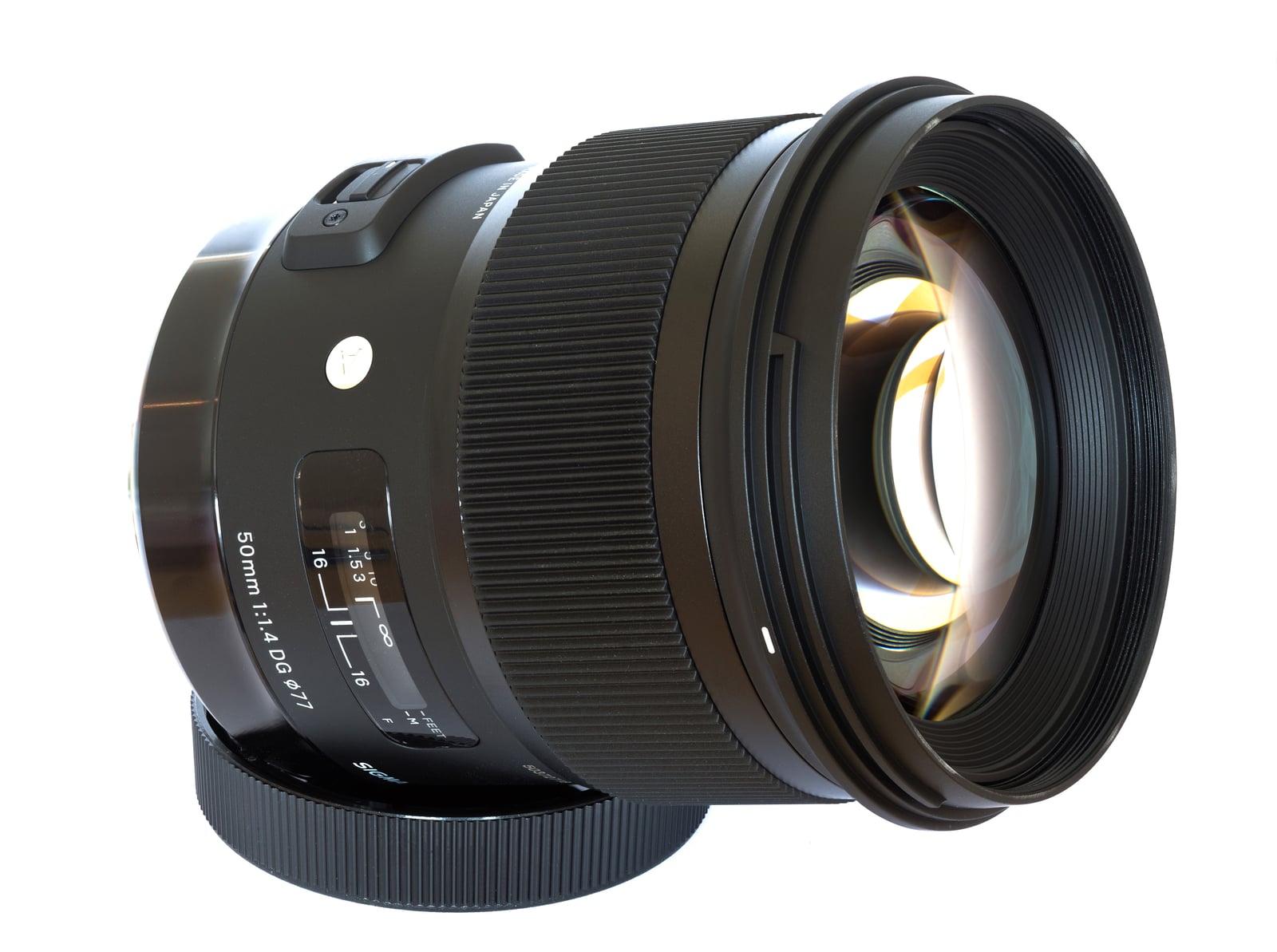
The accompanying archive photograph shows an older Sigma 50mm F1.4 Art prime in 2014, not this zoom or a sample image made with it. Specifications make the new offer worth examining; a representative project, compatibility check and honest assessment of how often it will be used make the eventual buying decision.
Source notes: 1, 3. Editorial interpretation and illustrative calculations are identified separately.
Sources & Methods
Prepared October 12, 2026. We read Sigma’s dated U.S. release, global specification table and American product listing, plus Canon’s background guide, originally published in 2023 and updated January 29, 2026. Prices are announced or displayed U.S. figures, not a checkout or local quote. The crop calculations, exposure-duration example and cost allocation are explicitly limited arithmetic, not benchmarks. Our proposed trials and buying view are original editorial analysis. We performed no optical, autofocus, stabilization, compatibility or weather-resistance test, purchase or interview.
- Sigma America: dated launch and announced U.S. price — Primary October 8 announcement; planned availability and handling claims, not independent testing
- Sigma: global specifications and qualification notes — Primary technical table checked October 12; mount differences, sensor coverage and qualified stabilization ratings
- Sigma America: current product listing — Primary U.S. price display checked October 12, 2026; not a completed checkout or delivery confirmation
- Canon: background lens concepts — Primary educational background; crop, aperture and lens terminology, not an evaluation of this Sigma lens