
A new route from one paper to its surrounding literature
NIH’s National Library of Medicine launched Linked Discoveries on September 24. The experimental resource represents more than 29 million PubMed publications and lets readers explore connections around an individual article. It is a discovery aid, not a new medical finding.
NIH describes the project as part of its work on replication and reproducibility, while explicitly saying the tool does not assess study quality or decide whether a finding has been replicated. That limit is central to understanding the launch: finding papers that belong in the discussion is a different task from determining what their evidence supports.
For a science reader, the appeal is straightforward. An exciting headline often points to one study. A useful next question is what else has been published on the same problem, including work that complicates the story. This tool offers another starting point for asking that question.
Source notes: 1. Analysis and proposed examples are identified in the text.
Similarity creates the neighbourhood; it does not certify agreement
According to the version 1.0 guide, a biomedical language model compares titles, abstracts and keywords; full article text is not used. By default the neighbourhood contains the starting article and 49 related records, with expansion to 200. Topic and citation labels are added after retrieval rather than determining which records enter the neighbourhood.
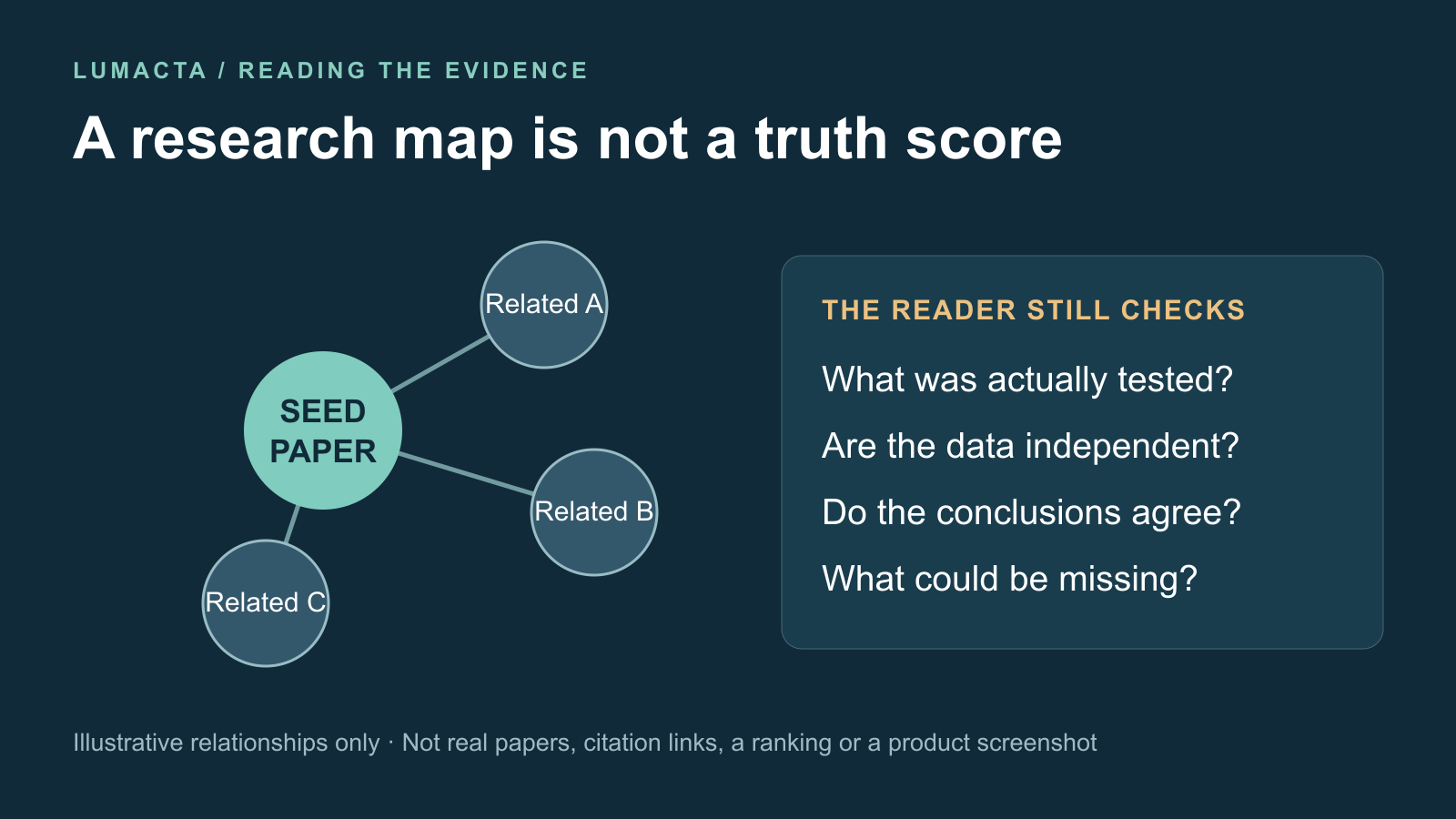
Our methodological interpretation is that being close in meaning does not establish independent confirmation. Two papers can ask nearly the same question while using different measurements or reaching opposing conclusions. A review and an original experiment can also discuss the same result without supplying two independent tests.
A reader should therefore treat proximity as an invitation to read, not as a vote. Ten nearby papers are not automatically ten replications. Before describing a finding as robust, establish what each paper actually tested and whether the underlying evidence is genuinely independent.
Source notes: 2. Analysis and proposed examples are identified in the text.
How to explore without confusing the display with a verdict
The guide directs users to the Linked Discoveries button on eligible PubMed abstract pages. Graph and timeline views show the neighbourhood; filters and a table help inspect it. Records without abstracts and preprint records are excluded. The pilot warns that results may be incomplete or inaccurate.
PubMed already offers Similar Articles, generated with a word-weighted comparison of titles, abstracts and indexing terms. Its documentation also warns that available citation links may be incomplete. Linked Discoveries should be understood as an additional exploration interface, not proof that ordinary search or reading references is obsolete.
Our suggestion is to write down the research question before opening the map. Otherwise the display can quietly redefine the task: interesting nearby papers may draw attention away from the population, measurement or comparison that originally mattered. A visually coherent collection can still be the wrong collection for that question.
Source notes: 2, 3. Analysis and proposed examples are identified in the text.
A practical reading method for a new scientific claim
Consider a hypothetical report about an AI system that classifies microscope images. Start a reading sheet with the exact claim: which images, what reference labels and which test population? Then separate papers into those that introduce a method, evaluate it on new data, review earlier studies or raise a concern. This is our proposed workflow, not a search we have executed.
For each apparent confirmation, check whether the authors reused the same dataset. A new algorithm comparison on the same images can be informative without showing that the result generalises to a new laboratory. Record that distinction in plain language instead of counting publication links as independent successes.
Next, use a separately constructed PubMed search and inspect relevant reference lists. PubMed contains citations and abstracts, with links to full text when available; inclusion in a search result is not the same as having read the methods. A missing paper should prompt investigation, not an immediate conclusion that it does not exist.
Source notes: 1, 3, 4. Analysis and proposed examples are identified in the text.
An empty space in the map is not evidence of an empty field
The guide notes that new records and topic annotations can arrive on different schedules. It also explains that absent topic labels do not necessarily mean a subject is absent from the article. A filtered view is therefore shaped by what has been indexed as well as by the research itself.
Our practical safeguard is to preserve the starting record, date and filter choices in a reading note. If a conclusion later changes, those details help distinguish new literature from a change in how the earlier search was framed. The goal is to make the path to the evidence understandable to another reader.
For a formal evidence review, a convenient neighbourhood should not silently replace a documented search strategy and explicit inclusion criteria. This article covers a research-navigation tool. It does not evaluate a treatment or provide a basis for an individual medical decision.
Source notes: 2. Analysis and proposed examples are identified in the text.
The success measure should be useful evidence found
Lumacta’s scientific perspective is that this kind of tool should be evaluated on the evidence it helps users find and the important material it misses. A polished graph or a large corpus count cannot answer that question on its own.
One possible evaluation would give readers the same clearly defined question and compare their results against a separately assembled reference set. Measure relevant papers found, important omissions and time spent checking irrelevant matches. Include contradictory and less-cited studies. This is a proposed test, not a result we can report for Linked Discoveries.
The useful promise is assistance with a difficult reading task while leaving judgment explicit. If the map helps someone discover a limitation they would otherwise miss, it has added value. If it encourages them to treat similarity as scientific consensus, the interface has been misunderstood. The difference depends on how the tool is used and evaluated.
Source notes: 1, 2, 3. Analysis and proposed examples are identified in the text.
Sources & Methods
Prepared September 27, 2026. We reviewed NIH’s September 24 launch and NLM/PubMed documentation, including the version 1.0 user guide. The microscope-image example and evaluation protocol are Lumacta proposals, not conducted experiments. We did not benchmark the tool, assess individual biomedical findings, interview researchers or provide medical advice.
- NIH: launch of Linked Discoveries (September 24, 2026) — Primary launch announcement, corpus scope and explicit assessment limits
- NLM: Linked Discoveries user guide, version 1.0 — Retrieval inputs, eligibility, display, indexing and pilot limitations
- PubMed: user guide — Existing Similar Articles method, search options and incomplete citation coverage
- PubMed: what the database contains — Citations, abstracts and full-text access boundaries