
Mercury capture is confirmed
ESA has confirmed that BepiColombo achieved orbital capture around Mercury. In an update posted at 00:56 UTC on November 22, its operations team said contact with the spacecraft had resumed and flight-dynamics specialists had verified capture, while controllers continued assessing telemetry.
The immediate achievement is a change in the mission’s future. BepiColombo can now proceed towards a programme of repeated observations around its destination, after an eight-year journey. The arrival matters because the most useful questions about Mercury require sustained measurements. A brief encounter can reveal a remarkable feature. Following how a planet and its surroundings behave takes a different observing opportunity.
Why reaching a nearby planet took eight years
Space.com’s November 21 preview describes a route with one Earth flyby, two Venus flybys and six Mercury flybys after the October 2018 launch. A power problem reduced the energy available to the transfer module’s electric propulsion and lengthened the journey. Its account explains the central navigation problem: a spacecraft approaching the Sun gains speed and must shed enough energy for Mercury to capture it.
That makes the mission a useful correction to the idea that distance alone determines a space journey. A destination has a position and a velocity. Reaching its neighbourhood is only part of the problem; arriving in a condition that permits the next operation is another. For BepiColombo, the long route was part of the engineering solution to getting a useful scientific payload into Mercury’s orbit.
Source notes: 7.
Two orbiters still have to become two observatories
ESA’s published arrival plan schedules the release of Japan’s Mio orbiter on December 9–10, followed by its sunshield on December 16. The European Mercury Planetary Orbiter, or MPO, is due to reach its final orbit on March 10, 2027. The timetable places the start of the science phase on April 6 and explicitly allows dates to change for operational reasons.
These steps explain the gap between an arrival announcement and routine observing. Each separation changes the configuration that engineers must operate. Commissioning then establishes how the spacecraft and instruments perform in that configuration. The practical milestone to follow after capture is therefore a named operation and its confirmed outcome, followed by readiness for coordinated measurements.
Source notes: 3.
A new view of a planet with unfinished questions
NASA’s mission overview identifies distinct roles for the two orbiters. MPO will investigate Mercury’s surface and interior, while Mio studies its magnetic environment. Earlier exploration gives the mission a substantial foundation: Mariner 10 made flybys, and MESSENGER spent more than four years in orbit before its mission ended in 2015. MESSENGER established major findings about the planet’s composition, geological history, magnetic field and polar ice.
That history makes the new mission scientifically interesting in a specific way. Researchers can ask which earlier conclusions hold when observations cover different places, times and conditions. A successor becomes valuable through the questions its observing design can resolve. The strongest eventual result will connect a measured difference with a physical explanation and show why an alternative explanation fits less well.
Source notes: 6.
The scientific advantage of looking from two places
JAXA explains that simultaneous magnetic measurements from two locations can help distinguish Mercury’s own field from disturbances associated with the surrounding space environment. Its mission description gives Mio instruments for particles, fields, waves, dust and the thin sodium environment, while MPO examines the surface and interior.
A scientific review by Milillo and colleagues describes the value of coordinated observations when Mercury’s environment changes across both space and time. It also emphasises the geometry, instrument pointing, resolution and timing that those observations require. Two spacecraft create an opportunity; the observing plan determines which comparisons become possible.
Consider the reasoning behind such a comparison. If a measurement changes along a spacecraft’s path, the instrument may have entered a different region, the environment may have changed while it travelled, or both may have happened. A second observation supplies another constraint. Scientists still need compatible timing and a model of what the instruments measure before interpreting the difference. This is why the coordination work is part of the science, rather than administrative preparation around it.
Instrument checks are already part of the story
ESA’s October 6 mission update reported that MPO’s instruments had been switched on together after transfer-module separation. It described early tests of the BELA laser altimeter, the MERTIS thermal instrument and the SIMBIO-SYS imaging system. Those were instrument-health and performance checks conducted before Mercury capture. They do not establish that the complete mission is already carrying out its planned orbital science programme.
For readers, this distinction keeps a dramatic arrival in proportion without diminishing it. Engineering evidence answers whether equipment responds and performs within the conditions tested. A scientific result needs an observation, calibration and an argument that the data support a particular interpretation. Both kinds of evidence matter, and they arrive on different schedules.
Source notes: 4.
What to watch after the arrival
Lumacta’s assessment is that the next compelling story will be the transition from a successful navigation milestone to a working pair of observatories. Follow the separation reports, the final-orbit announcements and the commissioning results. When the first science findings arrive, look for the question being tested, the instruments involved and the uncertainty that remains.
The promise is substantial because the mission has a clear observing idea behind it. The two orbiters can bring complementary evidence to the same planetary system. Confirmation of capture makes that programme closer to reality. Demonstrating the full programme will take the remaining operations and the measurements themselves.
Sources & Methods
We read ESA Operations’ confirmation and compared it with Associated Press reporting, the arrival timetable, mission updates, and JAXA and NASA records. The observing-strategy discussion draws on a scientific review. The commissioning implications are Lumacta analysis.
- ESA Operations confirms capture — Primary mission-team communication posted November 22, 2026 at 00:56:52 UTC. Directly read through the public Bluesky API from verified operations.esa.int.
- Associated Press reporting on Mercury orbit — Independent post-capture reporting by Marcia Dunn, November 22 UTC. AP reported ESA’s confirmation and obtained a comment from the project’s lead scientist by email.
- ESA arrival timetable — Primary dated plan, updated July 2026; future dates remain operational targets.
- ESA mission and instrument updates — Primary checks reported October 6, 2026. This page does not itself contain the fresh capture announcement.
- JAXA mission description — Primary scientific roles and rationale for simultaneous measurements; historical schedule entries are not used as fresh confirmation.
- NASA mission overview — Primary mission roles and Mercury exploration history; older forecasts and inconsistent flyby dates are not used as operational confirmation.
- Space.com’s arrival preview — Independent editorial reporting published November 21. Read as a preview and context, not as independent telemetry verification.
- Two-spacecraft observing strategy — Milillo and colleagues, Space Science Reviews (2020), arXiv record submitted 2022. Abstract read for methodological background, not a new mission result.
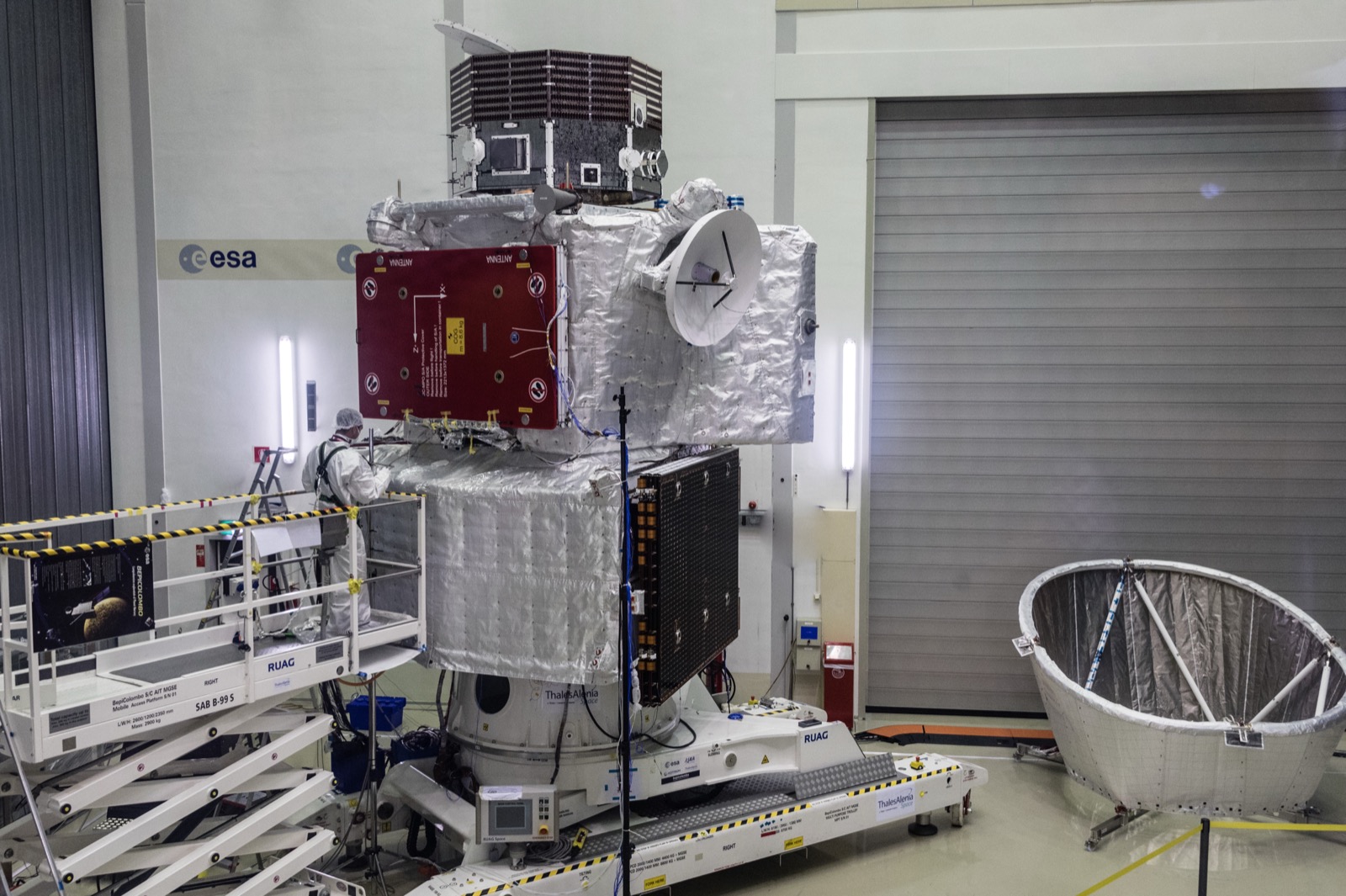
- BepiColombo stack — ESA–C. Carreau photograph captured July 5, 2017, published July 6; exact original EXIF agrees.
- Photo reuse licence — CC BY-SA 3.0 IGO; source, title, creator, licence and resize notice retained. The photograph remains under this licence.